
How to Choose the Best Off-Grid Solar System Without Overspending or Undersizing
Choosing the best off-grid solar system is not about buying the largest kit or copying someone else’s build. Reliable off-grid power comes from one core principle:
👉 Design for your worst production month — not your best.
Most system failures aren’t caused by bad equipment.
They’re caused by optimistic math.
This guide gives you the engineering logic needed to build a system that works in real weather, survives winter, and doesn’t destroy batteries prematurely.
Quick Verdict
- Best for full-time off-grid homes: 48V lithium system + DC-coupled architecture + inverter/charger
- Best for cabins: conservative battery bank + generator support
- Best for RVs: roof-sized array + lithium + MPPT
- Best budget strategy: modular expansion — panels first, batteries second
What “Best” Actually Means
A system is only “best” if it:
✔ Produces enough energy during the worst month
✔ Stores usable power kit without daily deep discharge
✔ Handles surge loads without shutdown
✔ Uses electrically compatible components
Anything less is not optimized — it’s gambling.
Step 1 — Measure Real Daily Energy Use
Off-grid starts with load math.
Watts × Hours ÷ 1,000 = kWh/day
Example:
Load | kWh |
Refrigerator | 1.5 |
Electronics + lights | 1.2 |
Pump + misc | 0.8 |
Total | ≈3.5 kWh/day |
If you don’t measure this, system sizing becomes guesswork — and guessing is how off-grid systems fail.
Step 2 — Size Panels for Winter (The Rule Most People Ignore)
Solar output changes dramatically by season.
Typical production ranges:
- Summer: ~4–6 kWh/day per kW
- Winter: ~2–3 kWh/day per kW (often lower)
A home using 3.5 kWh/day may need roughly:
👉 1.5–2.0 kW of solar
—not the 800W many kits recommend.
Oversizing panels is usually cheaper than oversizing batteries and dramatically improves recovery after cloudy periods.
⚠️ Hard Failure Example (Read This Carefully)
Here is what a failed system often looks like:
- 800W solar array
- 400Ah lead-acid bank
- Two cloudy days
Result:
- Batteries never fully recharge
- MPPT solar charge controller
- Depth of discharge increases daily
- Generator runs constantly
- Battery lifespan collapses
On paper, the system looked “complete.”
In reality, it was undersized.
Design margin is what separates reliable systems from frustrating ones.
Step 3 — Battery Strategy (Usable Energy Is What Matters)
Battery math:
Daily kWh × autonomy days ÷ usable capacity
Example:
3.5 × 2 ÷ 0.8 ≈ 8.75 kWh usable storage
Lithium vs Lead-Acid Reality
Factor | Lithium | Lead-Acid |
Usable capacity | ~80–90% | ~50% |
Cycle life | Much higher | Lower |
Maintenance | Minimal | Higher |
Long-term cost | Often lower | Often higher |
Lithium tolerates partial charging — critical for off-grid conditions.
Lead-acid can work for strict budgets, but repeated deep discharge shortens lifespan quickly.
Step 4 — Voltage Determines System Stability
- 12V → small systems / RV
- 24V → mid-size setups
- 48V → serious residential systems
Higher voltage reduces current, heat, and wiring loss — one of the simplest ways to increase reliability.
Step 5 — DC vs AC Coupling
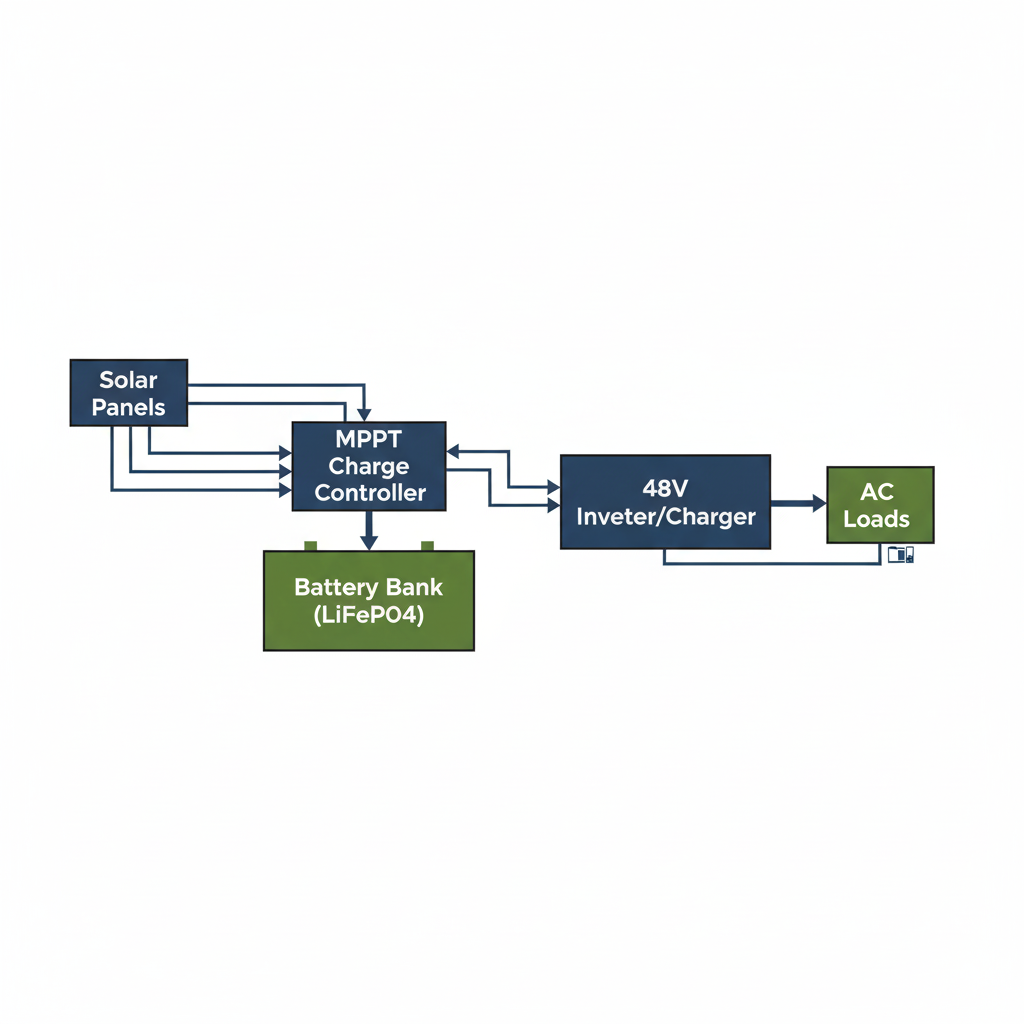
Most successful off-grid homes use DC-coupled systems:
Panels → Controller → Battery → Inverter
Advantages:
- Higher efficiency
- Simpler troubleshooting
- Fewer failure points
Also remember the “balance-of-system” equipment — wiring, disconnects, overcurrent protection, mounting system, and monitoring — all required elements in renewable installations according to the U.S. Department of Energy.
Step 6 — Inverter Sizing (Peak Power Rules Everything)
Average usage is irrelevant for inverter sizing.
Surge loads matter more.
Common surge sources:
- well pumps
- compressors
- refrigerators
- power tools
A home averaging 1,000W may still require a 3,000–6,000W inverter.
Undersized inverters don’t just inconvenience you — they make the entire system feel unstable.
Step 7 — Compatibility Checklist (Most Skipped Step)
Before buying any kit:
✔ Panel voltage fits controller limits
✔ Battery voltage matches inverter
✔ BMS supports inverter current
✔ Charging profiles align
✔ Wire gauge supports load
✔ Monitoring uses a shunt
Most “equipment failures” are actually compatibility failures.
Step 8 — Generator Integration (Engineering, Not Defeat)
Generators are normal in off-grid design.
They:
- protect batteries
- reduce oversizing costs
- improve system lifespan
Typical cost: $500–$2,000
The smartest off-grid systems are hybrid in behavior — solar first, generator when needed.
Off-Grid Solar System Cost — Real Expectations
Equipment-only ranges:
- Cabin / RV: $3K–$6K
- Full-time home: $8K–$20K+
Battery capacity is usually the largest driver.
If discussing federal incentives, anchor to the Internal Revenue Service and remember that eligibility for fully off-grid properties can be situational depending on installation details and current rules.
Avoid planning a system around credits alone.
Best System by Scenario
Scenario | Recommended Path |
Full-time home | 48V lithium + DC-coupled inverter |
Cabin | smaller bank + generator |
RV | lithium + MPPT |
Budget | modular expansion |
Decision matrix:
Best overall → 48V lithium
Best budget → modular
Best RV → roof-first sizing
Limitations Most Buyers Underestimate
- Winter production is the hardest constraint
- Perfect autonomy becomes exponentially expensive
- Batteries age — plan replacements
- Unlimited power requires utility-scale budgets
Understanding constraints is what creates reliable systems.
Who This Guide Is NOT For
This guide is not for:
- grid-tied homeowners chasing incentives
- anyone unwilling to run a generator occasionally
- buyers expecting unlimited power from a tiny array
Off-grid is engineering — not wishful thinking.
Final Decision Framework
- Measure real kWh/day
- Size panels for winter
- Choose lithium when possible
- Use 48V for larger loads
- Size inverter for surge
- Verify compatibility
- Plan generator support
Do this — and your system will outperform most packaged “best” kits because it was designed for reality.