
Bifacial Solar Panels: When They’re Worth It — and When They’re Mostly Marketing
Bifacial solar panels promise higher energy production by capturing sunlight on both sides of the module. On paper, that sounds like an automatic upgrade.
In reality, Bifacial solar panel performance is not guaranteed.
It is engineered.
When installed correctly, bifacial panels can deliver meaningful long-term gains. When installed poorly, they behave almost exactly like traditional panels — sometimes at a higher cost.
This guide explains the bifacial vs monofacial decision clearly so you can determine whether the extra complexity and price actually translate into usable energy.
Quick Verdict
Best use case:
Ground-mounted systems with reflective surfaces and strong clearance
Sometimes worth it:
Elevated flat roofs with white membranes
Usually not worth it:
Flush residential roof mounts
Key mindset:
Bifacial rewards site design — not brand selection.
⚠️ Hard Failure Example (Design Mistake)
A surprisingly common installation looks like this:
- bifacial panels mounted close to dark roofing
- minimal rear clearance
- tight rail spacing
Expected gain: 10%
Actual gain: ~1–2%
The owner paid more — and received almost no additional production.
The lesson is simple:
👉 Bifacial is not a technology upgrade.
It is a design strategy.
What Makes Bifacial Panels Different
Traditional panels capture sunlight only from the front.
Bifacial modules generate power from:
✔ direct irradiance
✔ reflected light
✔ scattered ambient light
The rear contribution — called bifacial gain — is the entire value proposition.
If rear irradiance is weak, the advantage disappears.
Bifacial vs Monofacial (High-Level Reality)
Feature | Bifacial | Monofacial |
Energy capture | Front + rear | Front only |
Typical gain | 0–15% | Baseline |
Installation sensitivity | High | Moderate |
Roof performance | Conditional | Predictable |
Ground performance | Excellent | Good |
Cost | Slightly higher | Lower |
Predictability is why monofacial panels still dominate residential rooftops.
The #1 Performance Driver — Albedo
Albedo measures how much light a surface reflects.
Typical values:
- white membrane → 0.6–0.8
- light gravel → 0.3–0.5
- grass → 0.15–0.25
- dark shingles → <0.1
If the surface beneath the panel is dark, rear production drops sharply.
Bifacial panels shine only when something bright is beneath them.
Where Bifacial Panels Actually Excel
✅ Ground Mount Systems
This is where bifacial truly performs.
Ideal conditions:
- elevated racking
- reflective ground
- wide row spacing
- minimal rear shading
Realistic gain: 5–15%
Higher with optimized engineering.
This is why many large-scale solar projects now deploy bifacial modules.
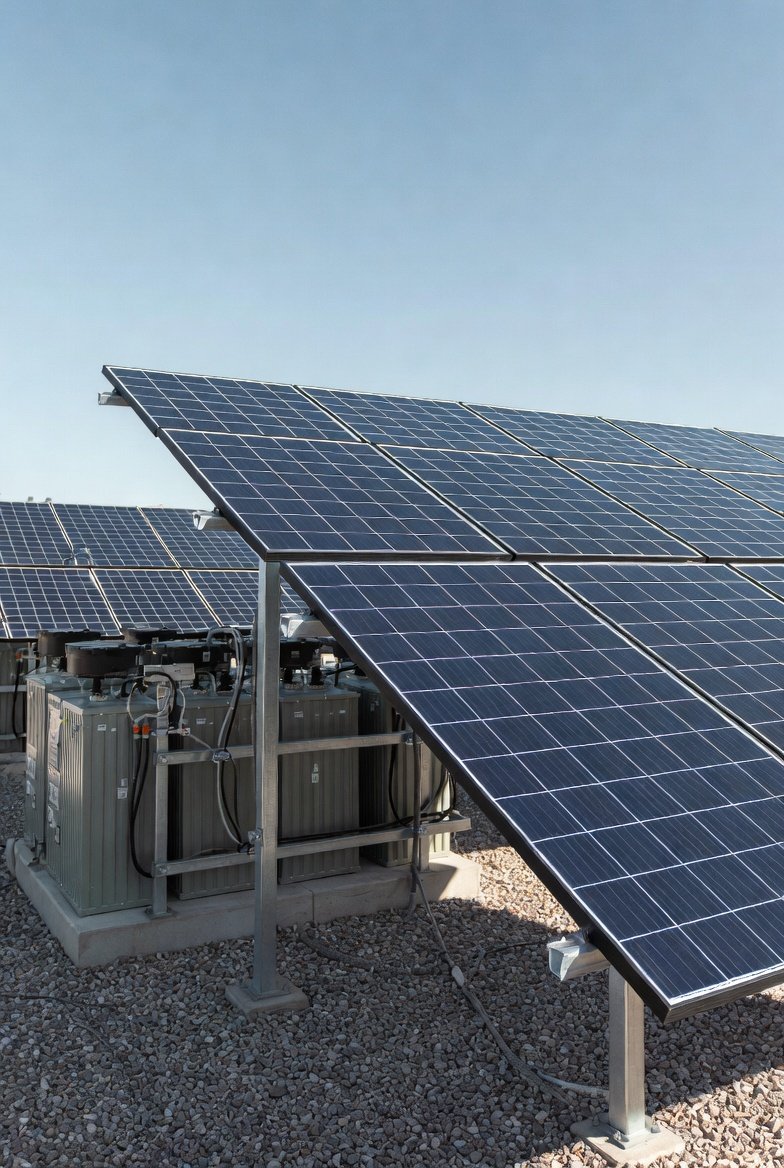
⚠️ Flat Commercial Roofs (Conditional)
Can work well when:
- roof membrane is white
- panels are elevated
- mechanical clutter is minimal
Typical gain: 3–8%
Flush mounting quickly erodes the advantage.
❌ Residential Pitched Roofs
Most homes simply lack the geometry needed.
Typical constraints:
- dark shingles
- tight mounting
- structural shading
Expected gain: often within measurement noise.
In these scenarios, bifacial is frequently marketing rather than meaningful performance.
Clearance, Height, and Rear Shading
Bifacial panels need physical space.
Rear output declines when:
- panels sit too close to the surface
- rails block reflected light
- conduit casts shadows
Simple rule:
👉 If light cannot easily reach the back — it cannot generate power.
Why Datasheets Mislead Buyers
Manufacturers list:
- bifaciality factor
- rear wattage
- lab test results
These are comparison tools — not production guarantees.
Real output depends on:
- geometry
- reflectivity
- climate
- seasonal sun angles
Use datasheets to compare modules — never to predict yield alone.
Cost vs Value — When Does Bifacial Pay Off?
Typical premium:
👉 ~5–10% higher upfront
The math works when:
✔ energy gain exceeds ~5%
✔ solar panel racking system operates for decades
✔ site supports rear irradiance
The math fails when:
- gains are minimal
- installation is constrained
- design is compromised
Bifacial is situational — not universal.
Bifacial in Off-Grid Systems
Extra production can help recharge batteries faster, particularly in winter when sun angles drop.
But bifacial does NOT replace:
- correct array sizing
- adequate storage
- load planning
- off-grid solar system
Think of bifacial as a multiplier — not a shortcut.
Durability & Construction
Most bifacial panels use dual-glass architecture.
Advantages:
✔ strong environmental resistance
✔ lower degradation
✔ structural rigidity
Trade-offs:
- heavier modules
- more deliberate mounting
For ground arrays, durability is often a net positive.
Look for modules tested to recognized safety standards such as UL 61730, which evaluates electrical and mechanical safety.
Certification signals engineering validation — not marketing claims.
Installation Mistakes That Destroy Gains
- flush mounting
- dark surfaces
- tight spacing
- structural shading
- chasing “newer” technology
Poor design can reduce bifacial output to monofacial levels.
Bifacial Suitability Check
Mostly “yes”?
- ground mount available
- reflective surface
- strong clearance
- minimal shading
👉 Worth serious consideration.
Mostly “no”?
👉 Monofacial is usually the smarter investment.
Limitations Buyers Underestimate
- gains are site-dependent
- residential benefit is often small
- design sensitivity is high
- installation quality matters
Bifacial rewards thoughtful engineering — and punishes shortcuts.
Who This Guide Is NOT For
This solar kit guide is not for:
- buyers assuming bifacial is automatically superior
- installations with tight roof constraints
- projects prioritizing lowest upfront cost
Predictable output often beats theoretical upside.
Final Decision Framework
Choose bifacial when:
✔ site design supports rear irradiance
✔ ground mounting is viable
✔ long-term yield matters
Choose monofacial when:
✔ installing on a typical residential roof
✔ simplicity is preferred
✔ cost-per-watt is the priority
Bifacial panels are not inherently better.
But in the right environment — they are absolutely worth it.