
How to Choose Lithium Solar Batteries That Actually Last in Off-Grid Systems
Lithium solar batteries have quietly become the backbone of modern off-grid power kit. But choosing the right battery is not about brand hype or chasing the newest spec sheet.
It is about chemistry stability, cycle behavior, temperature tolerance, voltage strategy, and how the battery performs after thousands of real charge–discharge cycles.
Most battery failures are not manufacturing defects.
They are design mistakes.
This guide explains how lithium solar batteries actually behave in off-grid systems, what real off-grid lithium battery cost looks like, and how to size storage so it lasts for years instead of degrading early.
Quick Verdict
- Best for full-time off-grid homes: 48V LiFePO₄ bank with integrated BMS and smart monitoring
- Best for cabins: modest lithium storage + oversized solar + generator
- Best for RV systems: 12V lithium matched carefully to inverter surge limits
- Safest budget strategy: start smaller, design expansion, oversize solar first
Why Lithium Changed Off-Grid Power
Lithium batteries behave fundamentally differently from lead-acid once installed.
What matters most in solar use:
✔ ~80–90% usable capacity
✔ Stable voltage under load
✔ Thousands of cycles with conservative use
✔ Minimal maintenance
This is why lithium now dominates new off-grid builds — even with higher upfront cost.
Lithium vs Lead-Acid (Reality Table)
Feature | Lithium (LiFePO₄) | Lead-Acid |
Usable capacity | 80–90% | ~50% |
Cycle life | Much higher | Lower |
Deep cycling | Tolerated | Damaging |
Maintenance | Minimal | Ongoing |
Long-term cost | Often lower | Often higher |
Most catastrophic battery failures still trace back to deeply cycled lead-acid banks.
⚠️ Hard Failure Example (Battery Edition)
A common failed design looks like this:
- 5 kWh battery
- undersized solar array
- daily 90–100% discharge
Within a year:
- usable capacity drops
- generator runtime increases
- voltage sags trigger inverter shutdowns
On paper, lithium “allowed” deep cycling.
In reality, lifespan collapsed.
Battery margin is not wasted money — it is stability.
Off-Grid vs Backup Lithium Batteries
Not all lithium batteries are designed for daily cycling.
True off-grid batteries must tolerate:
- daily solar charge/discharge
- partial state-of-charge
- generator charging
- winter idle periods
Backup-only batteries are engineered for outages — not everyday cycling.
Always verify the duty rating.
Step 1 — Size Battery Capacity Correctly
Battery sizing is about usable energy, not battery count.
Formula:
Daily kWh × autonomy days ÷ usable fraction
Example:
4 kWh × 2 days ÷ 0.8
≈ 10 kWh usable
Daily full discharge shortens lifespan — even if technically allowed.
Shallower cycling almost always wins long term.
Step 2 — Depth of Discharge Controls Lifespan
Daily Discharge | Long-Term Impact |
90–100% | Accelerated wear |
70–85% | Optimal lifespan |
<60% | Extremely long service life |
Battery longevity depends more on how you cycle it than which logo is printed on the case.
Step 3 — Temperature: The Silent Battery Killer
Charging lithium below ~32°F (0°C) can permanently damage cells unless protection exists.
Best practices:
- install batteries indoors or insulated
- use low-temp charge protection
- avoid hot mechanical rooms
Temperature planning alone can extend battery life by years.
Step 4 — Voltage Strategy (12V vs 24V vs 48V)
Voltage | Best Use |
12V | vans, very small loads |
24V | cabins, moderate demand |
48V | serious residential systems |
Higher voltage reduces current, wiring heat, and efficiency losses.
This is why most advanced off-grid systems center around 48V lithium banks.
Step 5 — BMS & Smart Monitoring (Non-Negotiable)
A lithium battery is only as reliable as its Battery Management System.
A proper BMS should:
✔ prevent unsafe charging
✔ block temperature extremes
✔ balance cells
✔ communicate with inverters when supported
Smart monitoring adds:
- accurate state-of-charge
- early fault detection
- cleaner generator integration
One of the biggest differences between budget and premium batteries is not chemistry — it is electronics.
Off-Grid Lithium Battery Cost (Real Expectations)
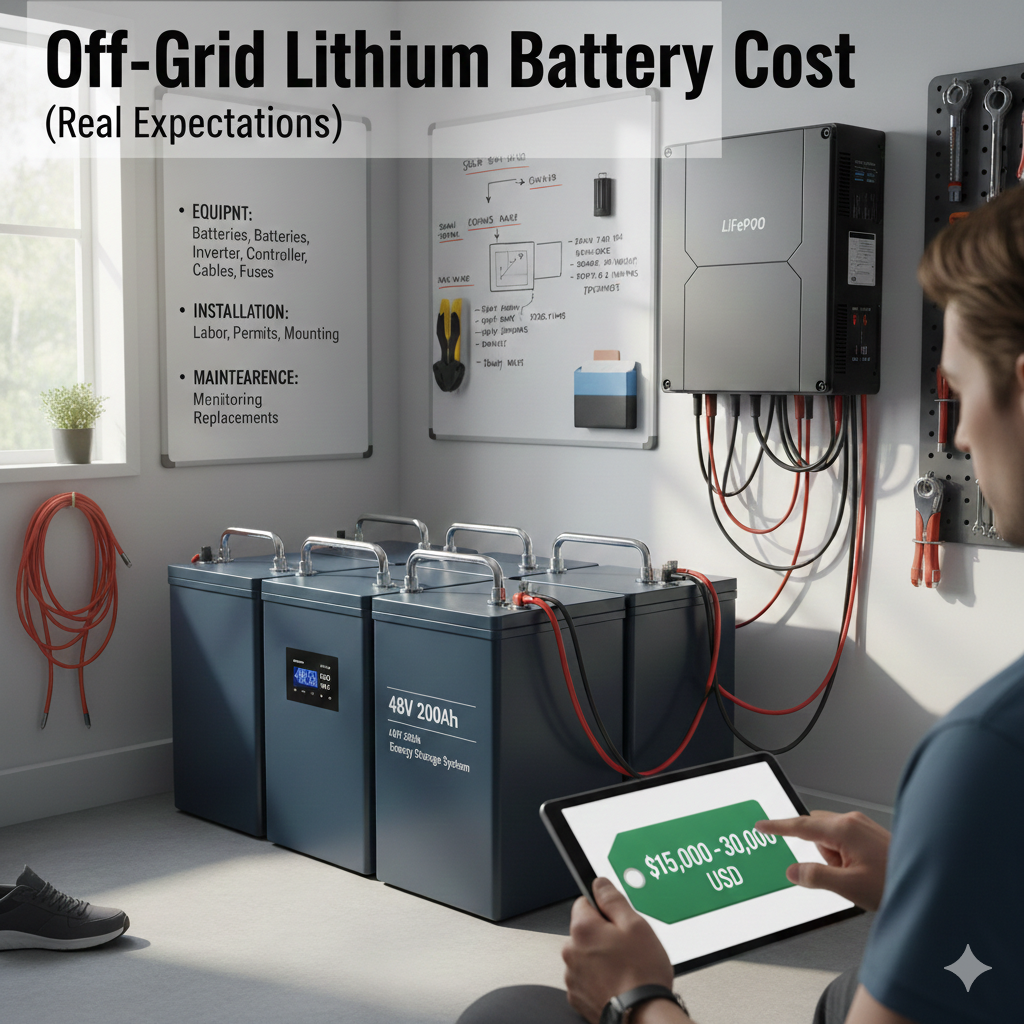
Typical battery-only ranges:
System | Cost Range |
RV / small cabin | $2K–$4K |
Mid-size cabin | $4K–$8K |
Full-time off-grid home | $8K–$15K+ |
Major cost drivers:
- chemistry
- warranty
- certifications
- BMS sophistication
- expandability
If discussing incentives, anchor to the Internal Revenue Service and remember eligibility for fully off-grid installations can be situational depending on system configuration and current rules.
Avoid designing around credits alone.
Why Oversizing Solar Often Beats Oversizing Batteries
System A
- smaller solar
- large battery
- deep daily cycling
System B
- larger solar
- moderate battery
- shallow cycling
System B typically wins long-term because battery stress drops dramatically.
Panels are cheaper than battery replacements.
Generator Integration (Normal Engineering)
Even lithium systems benefit from generators.
Real winter scenario:
- multiple cloudy days
- battery falls near 40%
- generator runs briefly
- batteries protected
Generators reduce how much storage you must buy and extend battery life.
Warranty vs Reality
Most warranties:
✔ cover defects
❌ do not cover misuse
Expect roughly:
10–15 years with conservative cycling.
Abuse any battery — and physics overrides warranty language.
Recycling & End-of-Life
Lithium batteries:
- last longer than lead-acid
- reduce replacement frequency
- are increasingly recyclable
Regional availability varies, but lifetime waste is typically lower.
Limitations Buyers Underestimate
- Lithium does NOT eliminate generators
- Cold climates require planning
- Warranties don’t override physics
- Perfect autonomy gets expensive fast
Understanding constraints creates reliable systems.
Who This Guide Is NOT For
This guide is not for:
- grid-tied homeowners chasing incentives
- buyers expecting unlimited power from a small battery
- anyone unwilling to plan backup
Off-grid reliability comes from engineering — not optimism.
Final Decision Framework
Choose lithium solar batteries if you want:
✔ long service life
✔ higher usable capacity
✔ lower maintenance
✔ strong long-term value
But size conservatively, protect against temperature extremes, use smart monitoring, and plan backup support.
That is how lithium delivers its real advantage.