
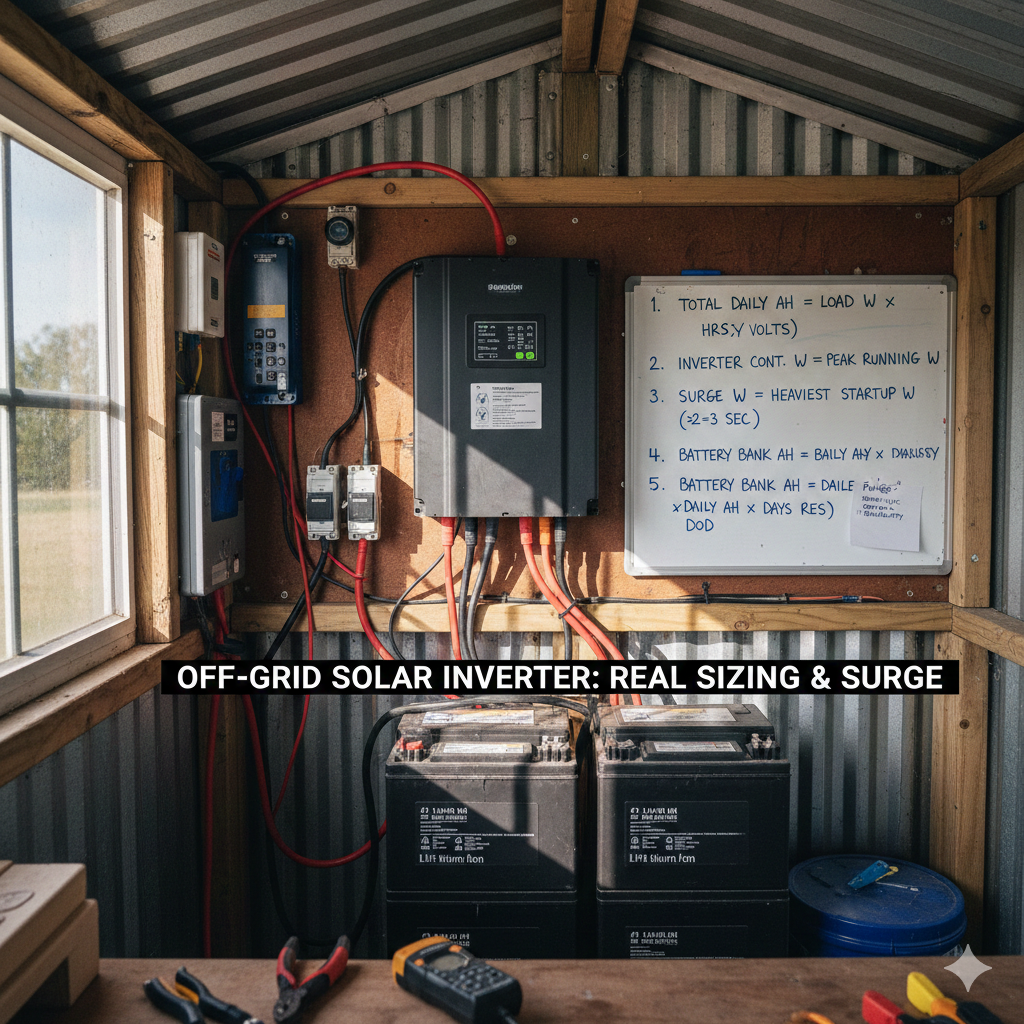
How to Choose an Off-Grid Solar Inverter Without Shutdowns, Overspending, or System Instability
An off-grid solar inverter is not just another component — it is the electrical brain of your entire system.
If it trips, everything stops.
Most off-grid failures do NOT originate from panels or batteries.
They start at the inverter.
Wrong size.
Wrong voltage.
Wrong surge handling.
Wrong charging logic.
This guide explains how to choose an inverter that runs quietly for years instead of becoming the weakest link in your power system.
Quick Verdict
- Best for full-time off-grid homes: 48V pure sine wave inverter/charger with strong surge capacity
- Best for cabins: mid-size inverter with low idle draw + generator input
- Best for RV systems: tightly sized 12V–24V inverter matched to real loads
- Safest budget path: proven inverter platform — not the cheapest box available
What an Off-Grid Solar Inverter Actually Does
Many buyers assume an inverter only converts DC to AC.
In reality, modern off-grid inverters often:
✔ manage battery charging
✔ coordinate generator input
✔ protect batteries
✔ stabilize voltage during surges
✔ act as the system’s transfer switch
If the inverter shuts down, stored solar energy becomes unusable — even with full batteries.
⚠️ Hard Failure Example (Inverter Edition)
A very common failure looks like this:
- Home load: 1,400W
- Refrigerator + pump start together
- Surge demand hits ~4,500W
- Installed inverter: 2,000W
Result:
- inverter trips repeatedly
- battery voltage sags
- electronics reboot
- compressor stress increases
- off-grid solar kit hub
The system “looked adequate” on paper.
But surge math was ignored.
Design margin is what separates stable systems from frustrating ones.
Off-Grid vs Hybrid vs Grid-Tie (Do Not Confuse These)
Off-Grid Inverter
- operates without utility power
- designed for full-time battery use
Hybrid Inverter
- can operate grid-connected
- more complex
- sometimes higher cost
Grid-Tie Inverter
- requires grid presence
- shuts down during outages
👉 If an inverter needs the grid to run, it is NOT off-grid — regardless of marketing language.
Step 1 — Size for Surge, Not Average Power
Most inverter mistakes come from sizing based on average usage.
That is incorrect engineering.
You must calculate simultaneous loads + surge demand.
Common surge appliances:
- well pumps
- refrigerators
- freezers
- compressors
- shop tools
A home averaging 1,200W may still need a 4,000–6,000W inverter.
Undersized inverters don’t just annoy users — they stress batteries and shorten equipment lifespan.
Step 2 — Use This Simple Sizing Method
Inverter sizing rule:
1️⃣ Add simultaneous running loads
2️⃣ Identify largest surge
3️⃣ Choose inverter with margin
Example:
- running load → 1,500W
- surge → 3,500W
👉 Safe choice: 4,000–6,000W inverter
Engineering rule:
Oversizing slightly improves stability.
Undersizing guarantees problems.
Step 3 — Idle Draw (The Hidden Battery Killer)
Every inverter consumes power — even when nothing is running.
Inverter Size | Typical Idle |
Small | 15–30W |
Medium | 30–60W |
Large | 60–100W+ |
Over 24 hours:
👉 idle draw alone can consume 0.5–2.4 kWh/day
On small systems, that can equal your lighting load.
Look for:
✔ low standby consumption
✔ search / sleep modes
✔ efficiency curves at low loads
Idle draw is one of the most underestimated design factors in off-grid systems.
Step 4 — Voltage Strategy (Why 48V Dominates Serious Systems)
Voltage | Best Use |
12V | vans, micro-systems |
24V | cabins |
48V | residential off-grid |
Higher voltage means:
- lower current
- less wiring heat
- improved efficiency
- better surge handling
Most experienced installers default to 48V solar batteries once loads grow beyond very small cabins.
Step 5 — Pure Sine Wave Is Mandatory
Modern motors and electronics expect clean AC power.
Pure sine wave:
✔ runs appliances cooler
✔ prevents buzzing
✔ protects electronics
Modified sine wave:
- cheaper
- inefficient
- causes heat
- accelerates appliance wear
For off-grid homes, modified sine wave is almost always false economy.
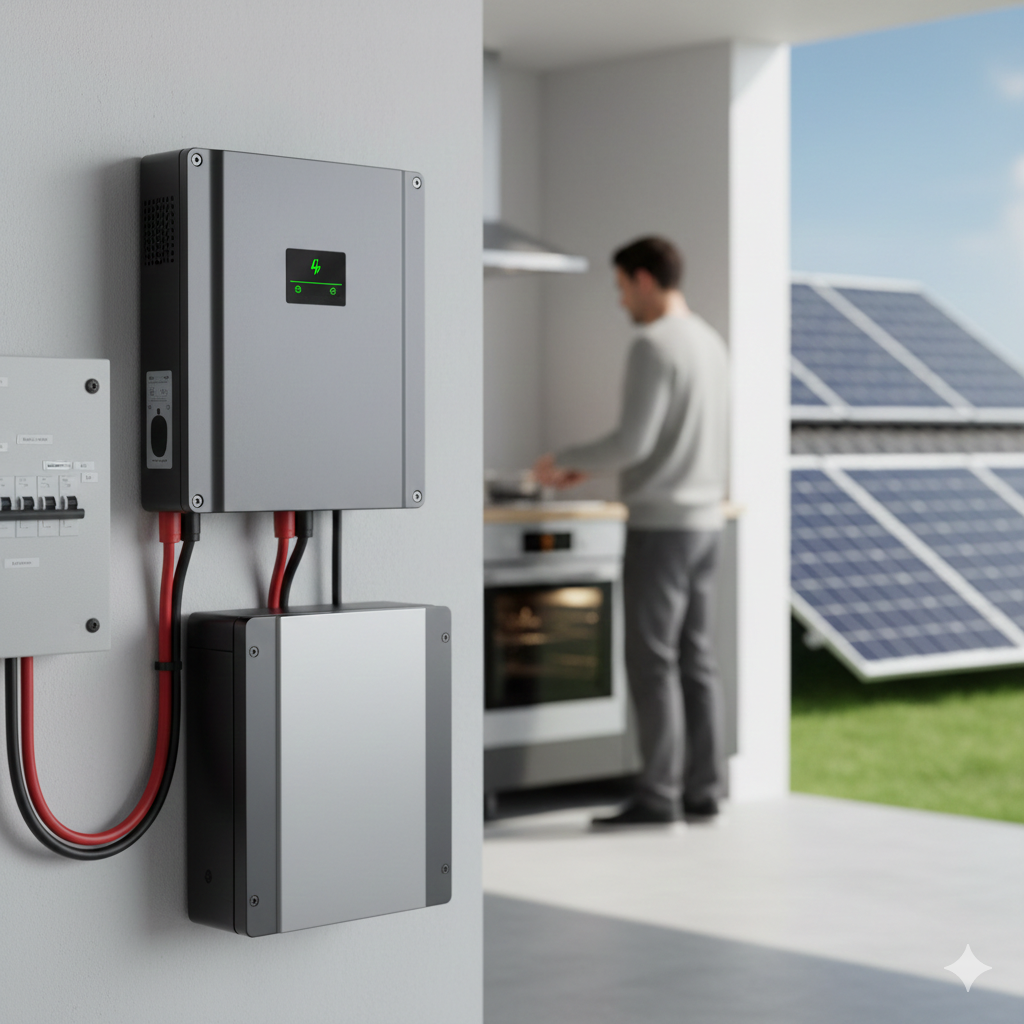
Solar Power Inverter for Home (Absorbed Intent)
When choosing a solar inverter for home use, plan beyond today’s loads.
Consider:
- 120V vs 120/240V split-phase
- future appliances
- generator compatibility
- battery expansion
Do You Need Split-Phase?
Often required for:
- well pumps
- large tools
- some HVAC
If it might happen later — plan now.
Replacing an inverter is expensive.
Step 6 — Inverter/Charger Value (Generator Integration)
Most modern off-grid inverters include charging capability.
They can:
✔ recharge batteries from generators
✔ automate load switching
✔ reduce generator runtime
Example scenario:
3 cloudy winter days → batteries reach ~40% → generator runs briefly → batteries protected.
But charging voltages must match battery specs.
Incorrect settings can shorten battery life rapidly.
Step 7 — Battery Compatibility
Your inverter must support:
✔ battery chemistry
✔ correct voltage targets
✔ temperature logic
✔ BMS communication (when supported)
Many budget inverters fail here — not in power output, but in charging precision.
Step 8 — Reliability Matters More Than Features
Panels may last decades.
Batteries often last 10–15 years.
Inverters commonly fail first.
Prioritize:
- warranty strength
- manufacturer support
- repair pathways
- firmware updates
- lithium solar batteries
An unsupported inverter becomes a single point of system failure.
Safety & Certification (Trust Wall)
Look for:
✔ UL 1741 certification
✔ proper grounding support
✔ integrated protections
✔ clear installation guidance
Certification signals electrical safety compliance — something insurers and inspectors often care about.
This is not where you cut corners.
Off-Grid Solar Inverter Cost (Reality Ranges)
System | Typical Cost |
RV / cabin | $800–$1,500 |
Mid-size | $1,500–$3,000 |
Full home | $3,000–$6,000+ |
Higher cost usually buys:
- stronger surge handling
- lower idle draw
- better support
- longer service life
Cheapest rarely equals safest.
Most Common Inverter Failure Scenarios
- undersized surge capacity
- excessive idle drain
- incorrect charging settings
- poor ventilation
- no generator path
All are preventable with correct selection.
Limitations Buyers Underestimate
- Bigger isn’t always better
- Idle draw scales with size
- Generator integration is normal
- Reliability beats features
Perfect electrical autonomy becomes expensive quickly.
Who This Guide Is NOT For
This guide is not for:
- grid-tied homeowners shopping for net-metering equipment
- buyers chasing the cheapest inverter available
- anyone unwilling to plan electrical margin
Stable off-grid systems are engineered — not improvised.
Final Decision Framework
Choose an inverter that:
✔ handles your largest surge
✔ matches battery voltage
✔ supports battery chemistry
✔ minimizes idle draw
✔ comes from a supportable platform
Get these right, and your inverter will quietly power your system for years — exactly what good infrastructure should do.