
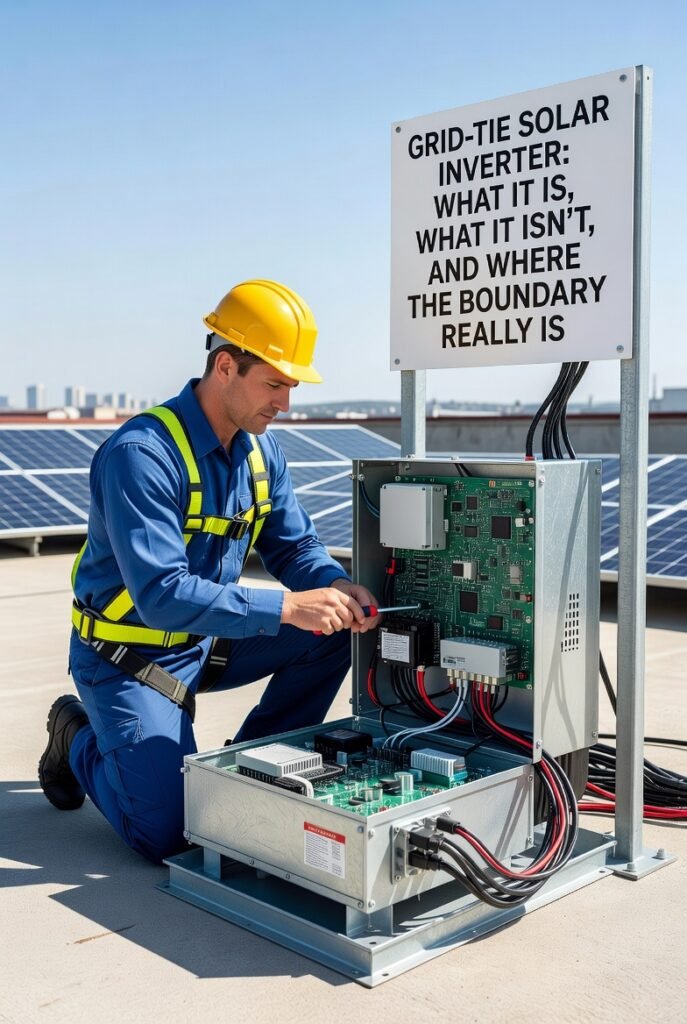
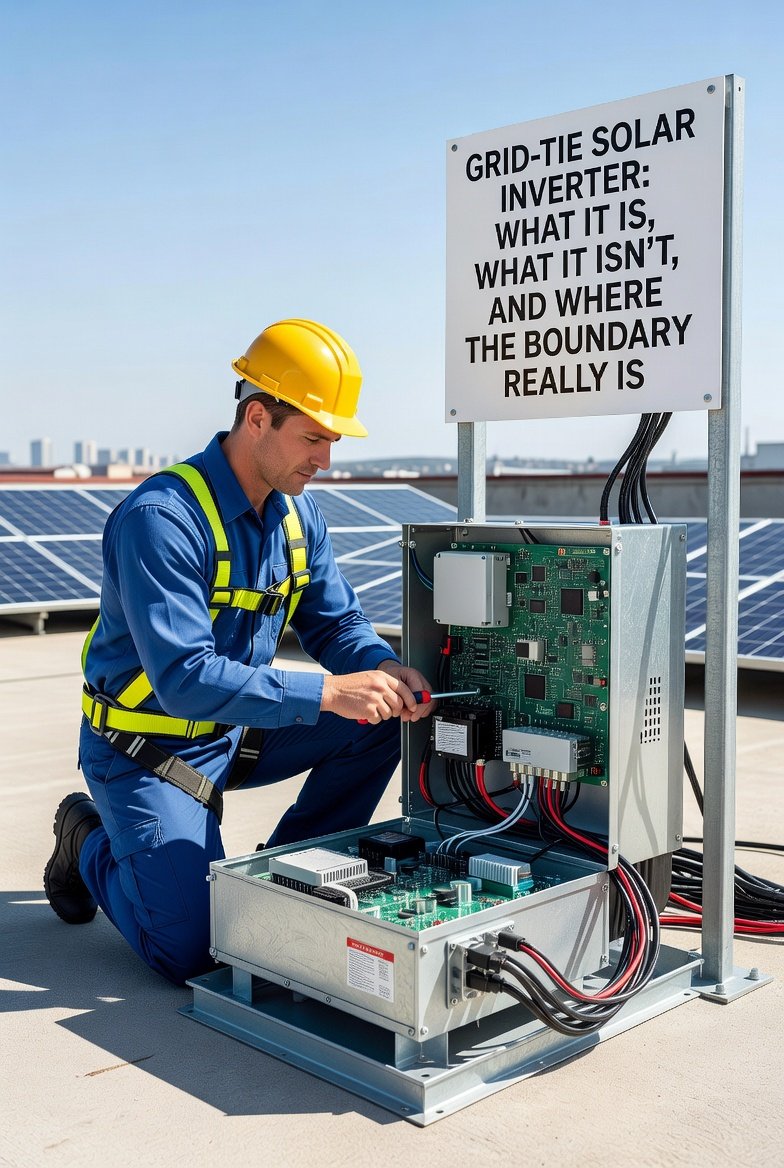
Grid-Tie Solar Inverter: The Boundary Definition Most People Miss
A grid-tie solar inverter is designed for one job:
Convert solar panel DC power into grid-synchronized AC power so your home can use it first and export excess to the utility.
That sounds simple.
But this device creates one of the biggest misunderstandings in residential solar:
Most grid-tie systems will NOT power your home during a blackout.
Not because panels stop working.
Not because solar “fails.”
But because a grid-tie inverter is engineered to follow the grid — not replace it.
That boundary is everything.
⚡ Quick Reality Check
If your system is grid-tie only:
- It shuts down when the grid goes down
- It cannot form its own microgrid
- Adding more panels will not fix outage power
- Backup requires different architecture
This page defines that boundary clearly — without mixing battery sizing, pricing pages, or hybrid design.
TL;DR — Grid-Tie Solar in Plain English
- Grid-tie = solar → home → grid
- It requires the utility grid to operate
- It shuts off during outages (anti-islanding)
- It’s excellent for bill reduction
- It is not designed for backup power
What a Grid-Tie Solar Inverter Actually Is
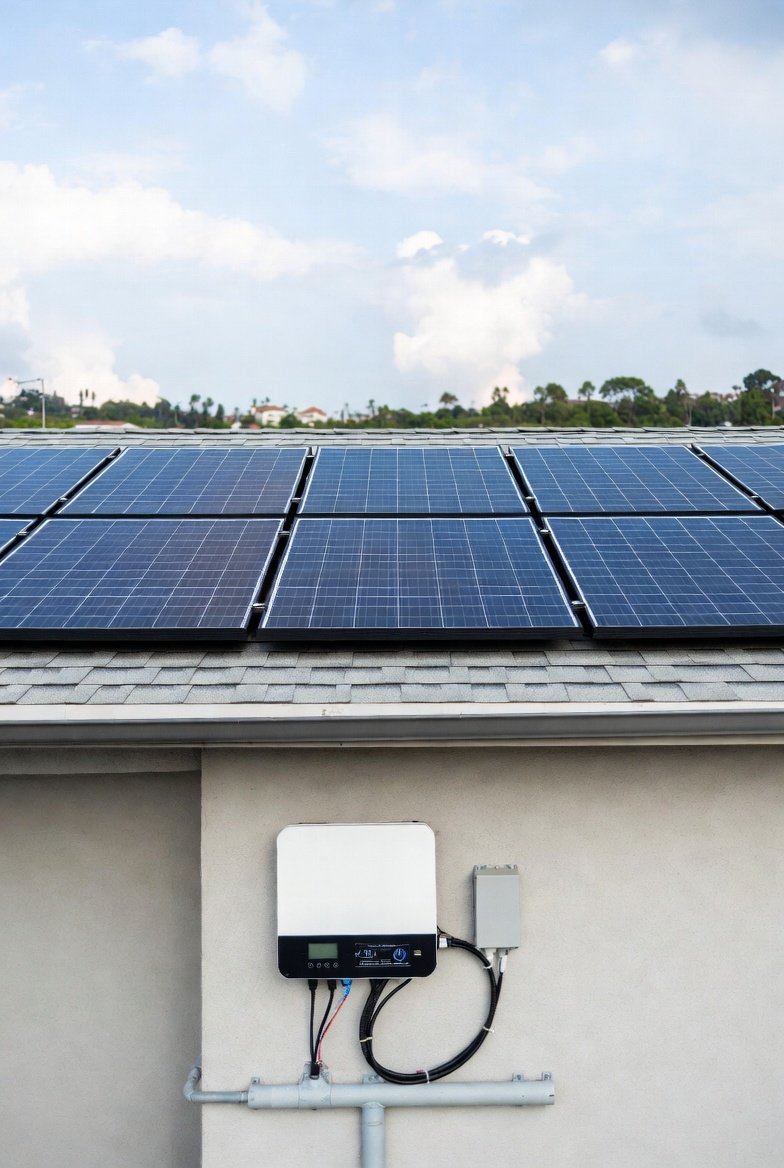
A grid-tie inverter sits between your solar array and your electrical panel.
It performs three core functions:
1) DC to AC Conversion
Solar panels produce DC. Homes use AC.
The inverter converts DC into usable AC power.
2) Grid Synchronization
It matches the grid’s voltage and frequency in real time.
This is called grid-following behavior.
3) Export Control
If your solar produces more than your home consumes, excess energy can flow outward through your meter (subject to your utility agreement).
That’s the grid-tie mission:
Make solar behave like a clean, compliant energy source inside a grid-connected home.
If you’re looking for inverter pricing and cost breakdowns:
solar cost
The Boundary Definition (The Core Principle)
Here is the cleanest definition:
A grid-tie inverter is not a backup inverter.
By default, a standard grid-tie system:
- Powers your home only while the grid is present
- Shuts down when the grid is down
- Does not isolate your home and keep circuits running
This is not a flaw.
It is intentional design.
The Point of No Return: Anti-Islanding Explained
The exact moment the grid fails, your grid-tie inverter:
- Detects loss of grid stability
- Immediately disconnects
- Stops producing power
This behavior is called anti-islanding.
Why?
Because during an outage:
- Utility line crews may be repairing lines
- Voltage conditions are unstable
- Backfeeding power could be dangerous
A grid-tie inverter must stop energizing utility lines.
Even if your panels are in full sun.
Even if your house could technically use that energy.
That shutdown is the boundary.
You cannot “software update” your way around it.
You must change architecture.
If backup is your goal, you’re now in:
https://offgridsolarkithub.com/hybrid-solar-inverter
Grid-Tie vs Hybrid vs Off-Grid (Clean Separation)
Feature | Grid-Tie | Hybrid | Off-Grid |
Works during outage | ❌ No | ✅ Yes (if designed properly) | ✅ Yes |
Requires batteries | ❌ No | ⚠ Optional but typical | ✅ Yes |
Primary goal | Bill reduction | Backup + flexibility | Independence |
Grid required | ✅ Yes | ⚠ Optional | ❌ No |
Complexity | Low | Medium | High |
This page owns the grid-tie boundary only.
Battery architecture lives here:
Voltage platform logic:
Why Grid-Tie Solar Shuts Off During Outages
People assume:
“If the sun is up, I should have power.”
But grid-tie systems rely on two realities:
1) Safety Separation
Solar must not energize utility lines when the grid is unstable.
2) Reference Dependency
Grid-tie inverters are grid-following devices.
They synchronize to an existing waveform.
Without that waveform, they cannot create one.
Only grid-forming inverters (hybrid/off-grid class) can do that.
Types of Grid-Tie Inverters
All of these are still grid-tie unless paired with storage and isolation.
1) String Inverters (Central)
DC from panel strings → One inverter → AC output
Advantages:
- Lower cost per watt
- Simpler system
- Easier ground-level servicing
Tradeoffs:
- Shade can affect string performance
- Single point of failure
2) Microinverters
Each panel has its own inverter.
Advantages:
- Panel-level monitoring
- Better shade tolerance
- Modular expansion
Tradeoffs:
- More roof-mounted electronics
- Roof access for service
3) Power Optimizers + String Inverter
Optimizers condition DC at panel level, central inverter converts to AC.
Hybrid string architecture for performance + centralized control.
All remain grid-tie unless battery backup is added.
What Grid-Tie Inverters Do Extremely Well
✔ Lower Grid Consumption
Solar powers your loads first.
✔ Export Excess Production
If allowed, excess flows outward under your utility agreement.
✔ Simple Daily Operation
No battery management
No runtime anxiety
Minimal user interaction
If your primary goal is reducing your electricity bill, grid-tie is often the cleanest architecture.
Where Grid-Tie Feels Limiting
Grid-tie becomes limiting when your goals shift toward:
- Backup power
- Nighttime self-consumption
- Grid instability resilience
- Time-of-use energy shifting
Those require battery coordination.
Residential battery framing:
household batteries
Full integrated packages:
solar-panel-kit-with-battery-and-inverter
Complete blueprint systems:
complete-off-grid-solar-system
Common Buyer Mistakes (Real-World Patterns)
- Assuming solar = backup
- Adding panels to “fix” outage behavior
- Confusing inverter power rating with system architecture
- Believing microinverters automatically provide backup
- Ignoring anti-islanding requirements
- Thinking hybrid functionality is “software unlocked”
Backup is structural — not cosmetic.
A Simple Decision Filter
Grid-tie is enough if:
- Outages are rare
- Your goal is bill reduction
- You prefer simplicity
- You don’t want battery management
You likely need hybrid if:
- You want outage power
- You want solar at night
- You want critical loads running
- You want partial independence
Boundary clarity prevents expensive redesigns later.
Permits & Interconnection (Why Grid-Tie Is Governed)
Grid-tie systems must meet:
- Utility interconnection standards
- Local electrical codes
- Rapid shutdown requirements (in many jurisdictions)
That’s why certified inverters and anti-islanding protection are mandatory.
This isn’t bureaucracy.
It’s grid stability engineering.
Scope Boundary (Anti-Cannibal)
This page owns:
- What grid-tie is
- Why it shuts down in outages
- String vs micro vs optimizer (in grid-tie context)
- When grid-tie is enough
It does NOT cover:
- Battery sizing
- Backup panel design
- Inverter cost breakdowns
- Full off-grid builds
Clean silos = stronger rankings.
Practical Close
A grid-tie solar inverter is the right tool when your goal is simple:
Reduce your grid bill.
It converts solar into compliant AC power and exports excess cleanly.
It is not designed to keep your house running during a blackout.
That boundary isn’t weakness.
It’s definition.
Once you understand that boundary, choosing your next step becomes clear:
Stay grid-tie for simplicity — or move into hybrid when resilience becomes the priority.
FAQs
What is a grid-tie solar inverter?
A grid-tie inverter converts solar DC into AC synchronized with the utility grid so your home can use solar energy and export excess power.
Why doesn’t grid-tie solar work during a blackout?
Because grid-tie inverters rely on the grid as a reference and must stop producing power during outages to prevent backfeeding.
Can I add batteries later to a grid-tie system?
Yes, but doing so usually requires adding a hybrid or battery inverter and proper isolation equipment.
Are microinverters still grid-tie?
Yes. Microinverters are still grid-tie devices unless paired with backup-capable system architecture.
Does grid-tie reduce my electric bill?
Yes. Solar powers your loads first, reducing energy purchased from the utility.
Is grid-tie the simplest solar setup?
Generally, yes. It has fewer components and requires no battery management.