
Household Batteries: How Residential Energy Storage Actually Works
Household batteries are often marketed as a simple upgrade: install one and your home gains backup power, independence, and peace of mind.
In practice, residential battery systems are not about the box on the wall.
They are about capacity limits, inverter power constraints, load management, solar recharge behavior, and realistic runtime math inside a real home.
Most disappointment with household batteries does not come from bad hardware. It comes from misunderstanding:
- kWh vs kW
- Partial vs whole-home backup
- Runtime expectations vs real load draw
- Winter solar limitations
- Financial return assumptions
⚡ Quick Reality Check
A household battery will not power your entire home unless:
- Your loads are intentionally limited
- Your inverter power matches real appliance demand
- You understand runtime math — not marketing claims
This guide explains exactly what household batteries can and cannot do in real homes.
TL;DR — Household Batteries in Reality
- Batteries store energy (kWh) but are limited by power (kW)
- Most homes should plan partial backup, not whole-home
- Runtime depends on loads, not battery size alone
- Solar extends backup — winter limits it
- Batteries buy resilience, not guaranteed ROI
What “Household Battery” Actually Means
A household battery is a stationary energy storage system permanently integrated into your electrical system.
Unlike portable units, these systems:
- Connect to the main panel
- Operate automatically during outages
- Cycle daily when paired with solar
- Scale modularly
They perform three core jobs:
- Store energy
- Deliver power
- Manage loads safely
If your primary goal is outage protection, understand how complete backup systems are structured:
solar backup
Energy (kWh) vs Power (kW): The Rule That Controls Everything
This distinction shapes real-world performance.
Energy (kWh) = how long loads can run
Power (kW) = what loads can run simultaneously
A battery with 15 kWh capacity but only 5 kW output cannot start certain large appliances even if energy remains.
Likewise, a 10 kW inverter with only 5 kWh storage will run heavy loads briefly — then shut down.
Many expandable systems use modular architectures. See how modular battery banks are typically scaled:
⚠️ Even large battery systems fail expectations when inverter power or load selection is ignored.
How to Estimate Your Backup Needs (5-Minute Method)
- List essential appliances
- Note running watts (ignore surge for now)
- Multiply by hours needed
- Add 20% buffer
- Compare against battery kWh and inverter kW
If inverter power is lower than appliance demand, runtime becomes irrelevant.
Before selecting equipment, it’s also helpful to understand inverter pricing ranges:
Real Runtime Example
Battery: 10 kWh usable
Inverter: 5 kW
Loads:
- Refrigerator: 150W (600W surge)
- Gas furnace blower: 600W
- Lighting + electronics: 300W
- Internet + small loads: 150W
Total ≈ 1.2 kW
10 ÷ 1.2 ≈ 8 hours theoretical
After inverter losses and reserve buffer:
≈ 6–7 hours realistic
Add central AC (3,000–5,000W)?
Runtime collapses rapidly.
This is why load selection matters more than raw battery size.
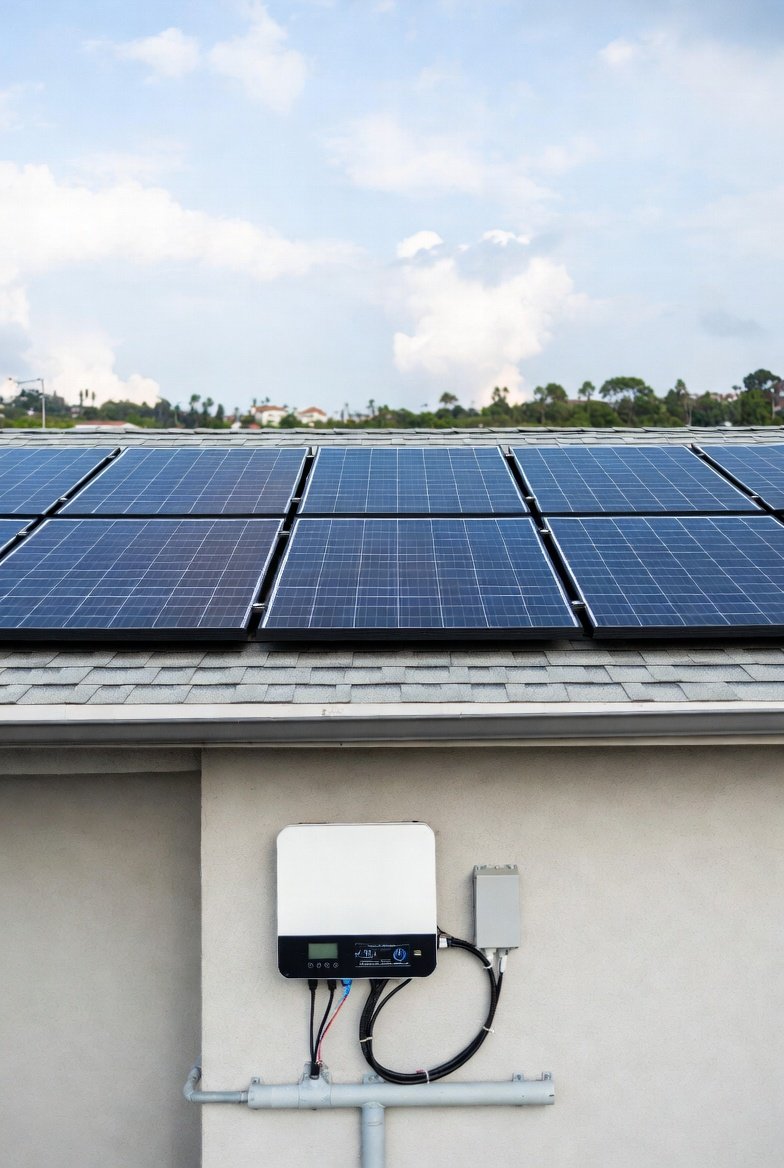
Winter Reality: The Quiet Limitation
In summer, solar can recharge batteries quickly.
In winter:
- Shorter daylight
- Lower panel output
- Snow cover risk
- Higher heating loads
A system that feels strong in July may feel tight in January.
If you’re building a system around solar charging, review how full residential kits are typically configured:
Winter performance planning separates resilient systems from frustrating ones.
Typical Roles of Household Batteries
1️⃣ Backup Power
Grid disconnect → battery powers selected circuits → solar replenishes (if available)
2️⃣ Solar Self-Consumption
Day: Solar → home → battery → grid export
Night: Battery → home
3️⃣ Load Shaping
Reduces peak usage
Improves stability
Supports time-of-use rate optimization
For lithium chemistry details and long-term degradation behavior, see:
Who Household Batteries Are (and Are Not) For
✅ Good Fit
- Homes with frequent outages
- Solar systems producing daytime excess
- Users prioritizing resilience
- Willing to manage loads intentionally
❌ Poor Fit
- All-electric heating homes
- Rare outages + no solar
- Expecting rapid financial ROI
- Very high overnight demand
Partial vs Whole-Home Backup
Partial Backup (Most Practical)
Backs up:
- Refrigeration
- Lighting
- Communications
- Essential outlets
Lower cost.
Predictable runtime.
High satisfaction.
Whole-Home Backup
Feeds entire main panel.
Requires:
- Multiple battery modules
- High inverter power
- Strict load management
Whole-home does not mean unlimited.
It means carefully controlled.
Typical Household Battery Sizing Scenarios
Home Type | Typical Battery Size | Backup Style | Realistic Runtime |
Apartment | 5–10 kWh | Essentials only | 4–8 hours |
Small Home | 10–15 kWh | Partial backup | 8–12 hours |
Medium Home | 20–30 kWh | Load-managed | 12–24 hours |
Large Home | 30+ kWh | Whole-home (managed) | Varies |
Runtime depends on behavior more than battery rating.
Common Household Battery Mistakes
- Assuming kWh = whole-home backup
- Ignoring inverter power limits
- Backing up too many circuits
- Expecting winter solar to fully recharge
- Buying batteries before auditing loads
Efficiency & Lifespan
Modern lithium systems:
- 85–95% round-trip efficiency
- 10–15 year typical lifespan
- 4,000–6,000 cycle warranties
- 70–80% retained capacity at warranty end
Scalable systems often use 48V architecture:
Planning voltage architecture early avoids redesign later.
Cost Reality
Installed residential battery systems typically range:
Small battery-only system:
$8,000–$12,000
Battery + inverter + partial backup panel:
$12,000–$18,000
Whole-home multi-battery systems:
$20,000–$35,000+
Costs vary by electrical upgrades and labor.
If considering bundled solutions, see how integrated systems are structured:
solar-panel-kit-with-battery-and-inverter
What Household Batteries Do NOT Solve
They do not:
- Generate energy
- Eliminate winter constraints
- Replace generators during prolonged storms
- Guarantee financial payback
They provide controlled resilience.
Not unlimited power.
Final Perspective
When:
- Capacity matches real essential loads
- Inverter power is respected
- Solar recharge behavior is understood
- Expectations are grounded in math
Household batteries become predictable and powerful.
Not magical.
Not infinite.
But reliable when engineered correctly.