
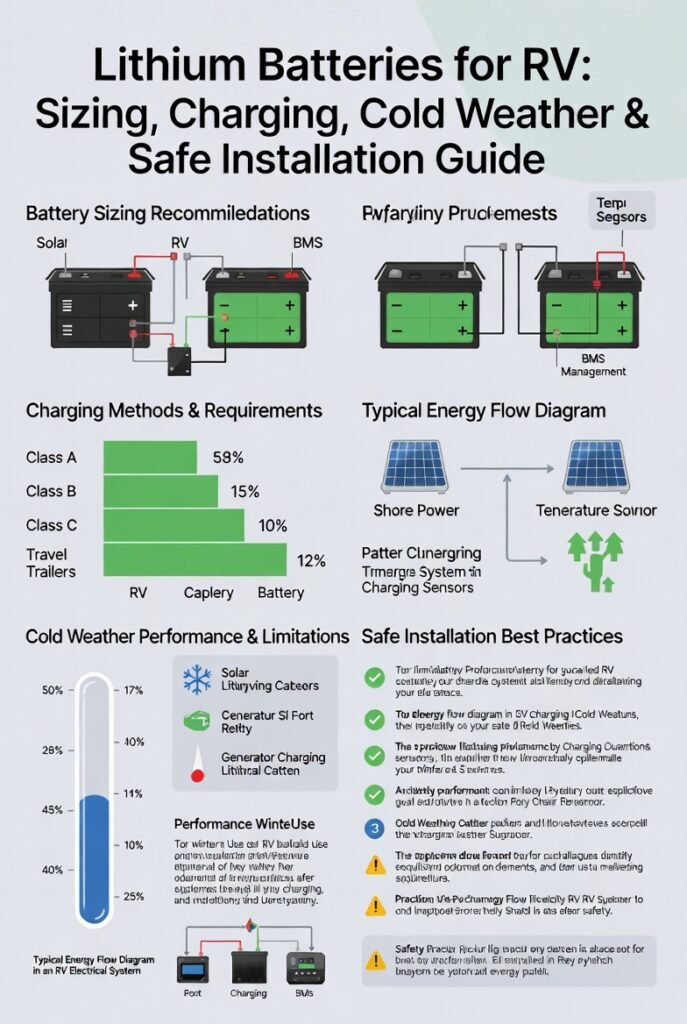
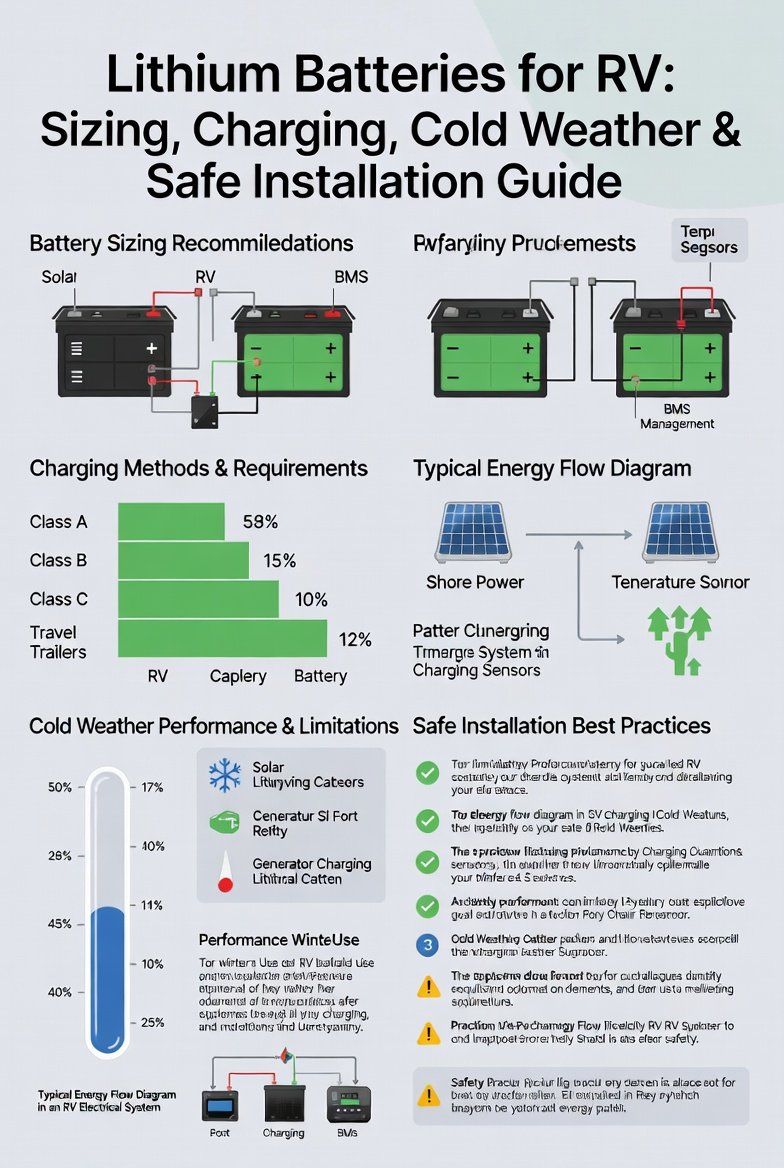
Lithium Batteries for RV: What Actually Works Long-Term
Lithium batteries can completely change how an RV feels to live in. Voltage stays steady. Lights don’t dim. Inverter loads feel less “fragile,” so you stop constantly watching a meter.
But most RV lithium failures don’t come from defective batteries.
They come from everything around the battery—alternators, converters, wiring, fusing, temperature, and current limits that were never designed for lithium behavior. Lithium doesn’t fail quietly. It exposes weak system design fast.
⚡ Quick RV Reality Check
A lithium upgrade will disappoint (or shut down) if:
- You connect lithium directly to the factory alternator with no current control
- Your inverter demands more amps than your battery BMS allows
- You try to charge below 32°F (0°C)
- You assume “drop-in” means plug-and-play
This guide covers what actually works long-term in RV lithium systems—sizing, charging from shore/solar/alternator, cold weather constraints, and safe installation.
TL;DR — RV Lithium in 60 Seconds
- Size by kWh per day, not just amp-hours
- Use a 30–60A DC-DC charger to protect the alternator and wiring
- Never charge lithium below freezing unless the battery has heating/protection
- Respect BMS discharge current limits (shutdowns are common when ignored)
- Slight oversizing = calm system; undersizing = constant stress
What “Lithium Battery” Means in RV Systems
In RV applications, lithium almost always means LiFePO₄ (lithium iron phosphate) house batteries.
Why RVers switch:
- Higher usable capacity (no “only use 50%” rule like lead-acid)
- Flatter voltage curve (more stable performance)
- Long cycle life
- Less weight for the same usable energy
The tradeoff is simple: lithium is less tolerant of bad charging and wiring.
If you want the chemistry-level breakdown (cycle life, degradation, safety profile) beyond RV framing:
The Two Numbers That Matter More Than Brand
1) Energy (Ah → Wh → kWh)
Amp-hours are common in RV marketing, but kWh is the honest comparison.
Wh = Volts × Ah
Typical 12V lithium (12.8V nominal):
- 100Ah ≈ 1.28 kWh
- 200Ah ≈ 2.56 kWh
- 300Ah ≈ 3.84 kWh
That’s your storage “fuel tank.”
2) Current (Amps) — the shutdown trigger
Every lithium battery has a BMS (Battery Management System) that enforces:
- Max discharge current (continuous)
- Surge current limits (short bursts)
- Max charge current
- Low-temp charge cutoff (many models)
If your inverter or loads pull more amps than the BMS allows, the battery can shut off even at 100% SOC.
⚠️ Many “my lithium is broken” stories are just BMS current limit events.
How to Estimate Your RV Battery Needs (5-Minute Method)
- List your essential devices (fridge, lights, fans, CPAP, laptop, etc.)
- Estimate daily watt-hours (or use a kill-a-watt when on shore power)
- Convert to kWh/day
- Choose 1–2 days of autonomy
- Add a 20% buffer for real-world losses
Then confirm your inverter won’t exceed the battery’s current limits.
If you’re planning heavy inverter loads, it helps to understand inverter sizing/cost bands:
solar cost
Practical RV Lithium Sizing (Real-World Ranges)
Typical daily energy usage:
- Light boondocking: 1–2 kWh/day
- Moderate use (12V fridge + devices + TV): 2–4 kWh/day
- Heavy inverter lifestyle (microwave, coffee, cooking): 4–8+ kWh/day
Most RVers target 1–2 days of autonomy without charging.
Example sizing:
- 3 kWh/day × 2 days = 6 kWh usable
- That’s roughly 4 × 100Ah 12V lithium batteries (or fewer larger modules)
A slightly oversized bank feels calm. An undersized bank feels like you’re always negotiating with power.
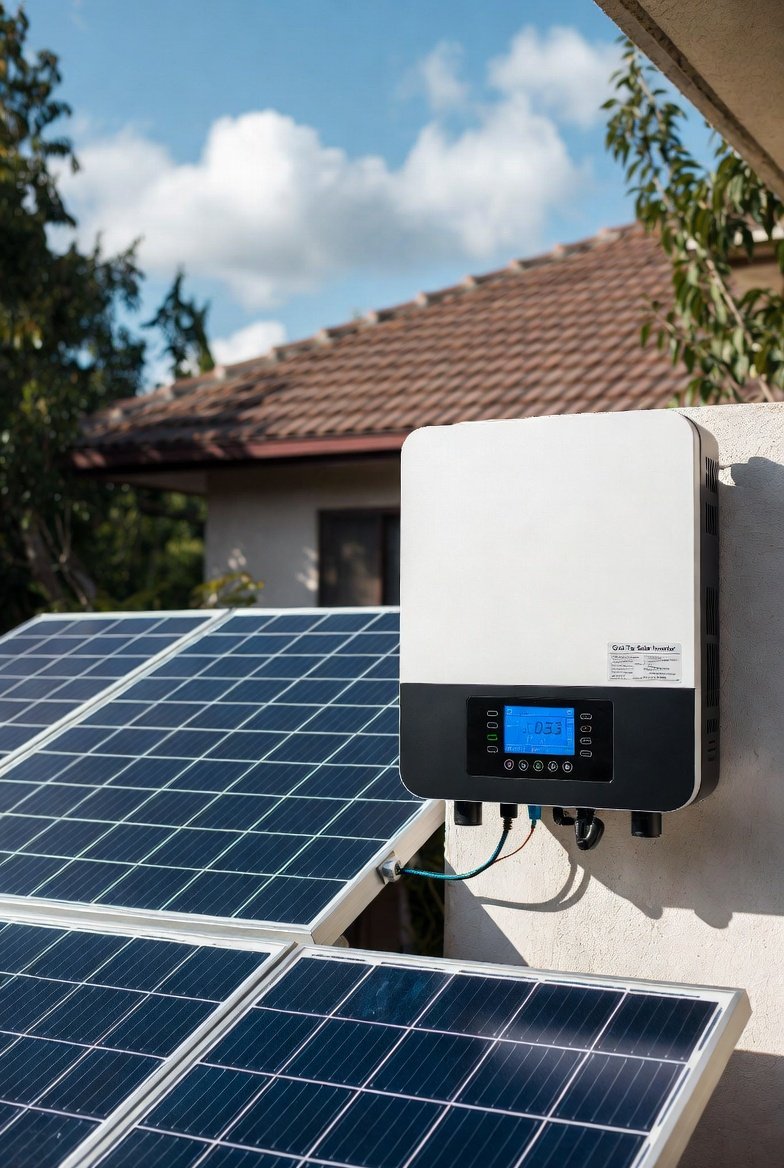
If you’re pairing lithium with solar at the same time (common upgrade path), see how integrated systems are typically structured:
solar-panel-kit-with-battery-and-inverter
Typical RV Lithium Sizing Scenarios
RV Type | Typical Bank | Typical Inverter | Use Style |
Small Van | 100–200Ah | 1000W | Weekend/light off-grid |
Travel Trailer | 200–400Ah | 2000W | Moderate boondocking |
Fifth Wheel | 400–600Ah | 3000W | Extended stays |
Residential Build | 600Ah+ | 3000W+ | Heavy inverter loads |
Battery size must match inverter size and wiring/fusing.
“Drop-In Lithium” Isn’t Truly Plug-and-Play
Lithium batteries may physically replace lead-acid, but your RV charging system usually doesn’t.
Three areas almost always need attention:
1) Converter / Charger (shore power)
Your stock converter may be lead-acid tuned.
Lithium needs:
- Correct absorption voltage
- No “long float forever” behavior
- Charge current that matches the battery’s rating
2) Solar Charge Controller
You want:
- Lithium profile (or custom setpoints)
- Temperature awareness
- Proper wiring to minimize voltage drop
If you’re building out a battery bank and solar together, this battery architecture guide helps:
solar battery bank
3) Alternator Charging (most failures happen here)
Lithium can accept high current continuously.
Factory alternators and wiring often cannot supply that safely for long.
Best practice:
Use a DC-DC charger between alternator and lithium bank.
Typical RV-safe range:
- 30A–60A DC-DC charger
This:
- Limits current
- Protects alternator
- Prevents hot wiring runs
- Provides a controlled lithium charging profile
Direct alternator-to-lithium connections are one of the most common failure paths.
Cold Weather: The One Rule Lithium Does Not Bend
LiFePO₄ should not be charged below 32°F (0°C).
Reality:
- Discharging in cold is usually OK
- Charging below freezing can permanently damage cells (unless protected/heated)
Practical winter solutions:
- Battery with low-temp charge cutoff
- Self-heated lithium model
- Mount batteries in a heated compartment
- Delay charging until the space warms
If you camp in winter, this is not optional knowledge.
Inverter Loads That Force System Upgrades
Lithium makes it tempting to power everything.
Loads that usually trigger redesign:
- Microwave / coffee maker
- Induction or electric cooking
- Power tools
- Air conditioner (high demand)
Lithium supports these only when:
- Inverter size is appropriate
- Wiring is heavy enough (often 4/0 AWG for 200A+ inverter feeds)
- BMS current limits are respected
- Fusing and disconnects are correctly installed
A “big battery” with thin wiring is still a weak system.
Safe RV Lithium Installation (Non-Negotiable)
Minimum safety stack:
- Main battery disconnect (accessible)
- Shunt-based battery monitor (accurate SOC)
- Proper cable sizing (voltage drop controlled)
- Class T fuse on the main battery positive (handles high fault current)
- Short, supported cable runs
- Secure mounting (vehicles move)
Skipping protection doesn’t save money—it pushes cost into failure and troubleshooting.
Post-Install Verification Checklist
After installation, confirm:
- Battery voltage and SOC behavior makes sense
- Converter/charger absorption and current limits are correct
- DC-DC charger output current matches design
- BMS data shows no current or temp faults
- Shunt monitor reads accurately at rest and under load
Most “mystery” lithium problems are caught here.
Common RV Lithium Mistakes
- Assuming kWh = whole-RV power
- Skipping DC-DC charging
- Ignoring BMS discharge limits
- Charging below freezing
- Undersizing the bank
- Using factory wiring for high inverter loads
- No Class T fuse / no disconnect
Most lithium failures are system design errors—not chemistry problems.
Boundary Clarity (Anti-Cannibalization)
This page covers RV-specific lithium systems:
- RV loads
- Alternator charging
- Cold weather rules
- Vehicle-grade safety stack
It does not replace:
Household home systems:
household batteries
Static off-grid solar systems:
off grid solar system
48V platform overview (rare for RV “house” systems):
48-v solar battery
Practical Close
Lithium batteries can be one of the best RV upgrades—when the system around them is designed for lithium behavior.
Proper sizing. Controlled charging. Cold-weather awareness. Serious protection.
If lithium fails in an RV, it’s rarely the battery.
It’s the system.
FAQs
Are lithium batteries worth it for an RV?
Yes—if your charging system, wiring, and protection are designed correctly. Lithium gives higher usable capacity, stable voltage, and long cycle life.
Do I need a DC-DC charger for RV lithium?
In most cases, yes. A 30–60A DC-DC charger limits alternator load, protects wiring, and provides controlled charging.
Can lithium RV batteries charge below freezing?
No. Charging below 32°F (0°C) can damage LiFePO₄ cells unless the battery includes heating or a low-temp charge cutoff.
Why is a Class T fuse recommended for lithium?
Lithium can deliver very high fault current during a short circuit. A Class T fuse is designed to interrupt that safely.
How do I choose the right lithium battery size for my RV?
Estimate daily kWh usage, decide how many days of autonomy you want, add a buffer, then confirm your inverter and BMS current limits match the plan.
Will lithium batteries run an RV air conditioner?
Sometimes, but it usually requires a large battery bank, a properly sized inverter, heavy wiring, and disciplined load management. Many RV setups need generator support for long AC runtimes.