
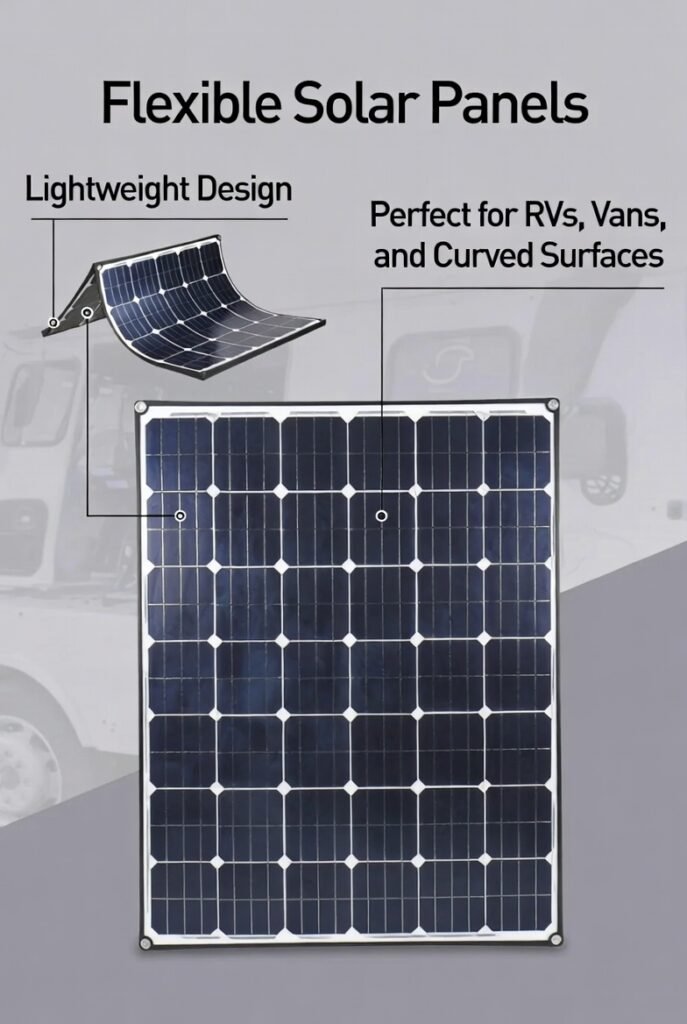
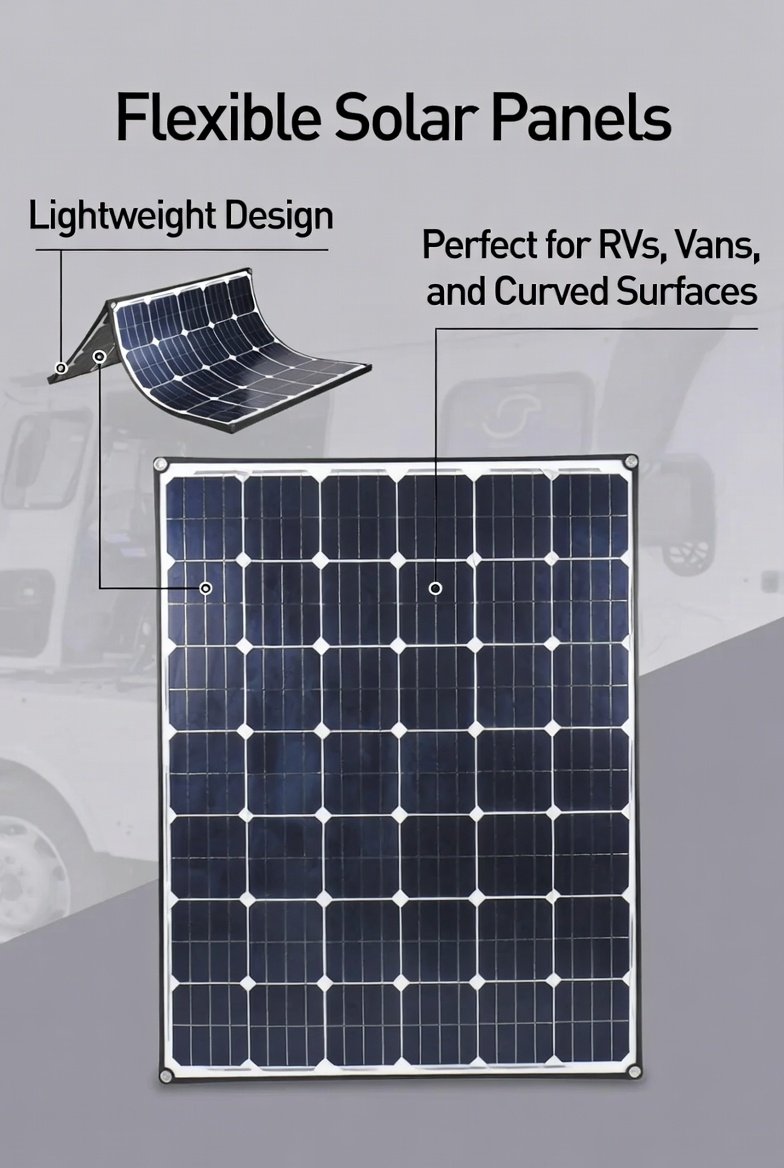
Flexible Solar Panels: When Lightweight Panels Make More Sense Than Rigid Solar
Most solar panels are rigid.
They are mounted in aluminum frames, installed on brackets, and positioned several inches above a roof surface.
This design works well for homes and large RVs.
But some installations create a different challenge.
Curved RV roofs.
Boat decks.
Lightweight vehicles.
Surfaces where mounting brackets are impractical.
In these situations, flexible solar panels solve a mounting problem that rigid panels cannot.
Flexible panels are thin, lightweight, and capable of bending slightly to follow curved surfaces.
However, flexible panels are not simply “better solar panels.”
They are a specialized panel format designed for specific installation environments.
Understanding where flexible solar panels work — and where they do not — is essential before choosing them.
Short Answer
Flexible solar panels are thin, lightweight photovoltaic panels designed to bend slightly and mount directly onto curved or irregular surfaces. They are commonly used on RV roofs, boats, and van builds where rigid panels are difficult to install. While flexible panels are easier to mount and lighter than rigid panels, they typically run hotter and may have shorter lifespans.
What Flexible Solar Panels Actually Are
Flexible solar panels are thin photovoltaic panels built without rigid aluminum frames.
Instead of glass and heavy mounting hardware, flexible panels typically use:
- thin photovoltaic cells
- polymer protective layers
- flexible backing materials
- lightweight wiring connectors
The result is a solar panel that weighs significantly less than traditional rigid panels.
Most flexible panels are only a few millimeters thick and can bend slightly to match curved surfaces.
These characteristics make flexible panels particularly useful for installations where traditional panels are difficult to mount.
Why Flexible Solar Panels Exist
Flexible solar panels were developed to solve installation challenges that rigid panels cannot handle.
Curved Surfaces
Rigid panels cannot easily mount onto curved roofs or decks.
Flexible panels can follow gentle curves found on:
- RV roofs
- marine vessels
- van conversions
This allows solar generation on surfaces that would otherwise be unusable.
Weight Restrictions
Some vehicles and small structures cannot support the weight of rigid solar panels.
Flexible panels are significantly lighter, making them suitable for:
- lightweight camper vans
- small boats
- mobile setups
Because they add minimal weight, flexible panels help maintain vehicle efficiency.
Low Profile Installations
Flexible panels can mount directly onto surfaces.
This produces a low-profile installation with minimal aerodynamic drag.
For RV and marine setups, this can be an advantage compared to raised panel mounts.
Scope Note
This guide explains what flexible solar panels are, how lightweight solar panels work, where they perform best, and how they compare to rigid solar panels. It does not cover product recommendations, brand comparisons, or full off-grid system design.
How Flexible Solar Panels Work
Flexible solar panels operate using the same photovoltaic process as traditional panels.
The basic solar system flow remains identical:
Solar panel → charge controller → battery → electrical loads
- Solar cells convert sunlight into direct current electricity.
- A charge controller regulates voltage and current.
- Batteries store the electricity produced during the day.
- Electrical devices draw power from stored energy.
A full off-grid system architecture is explained here:
best off grid solar system
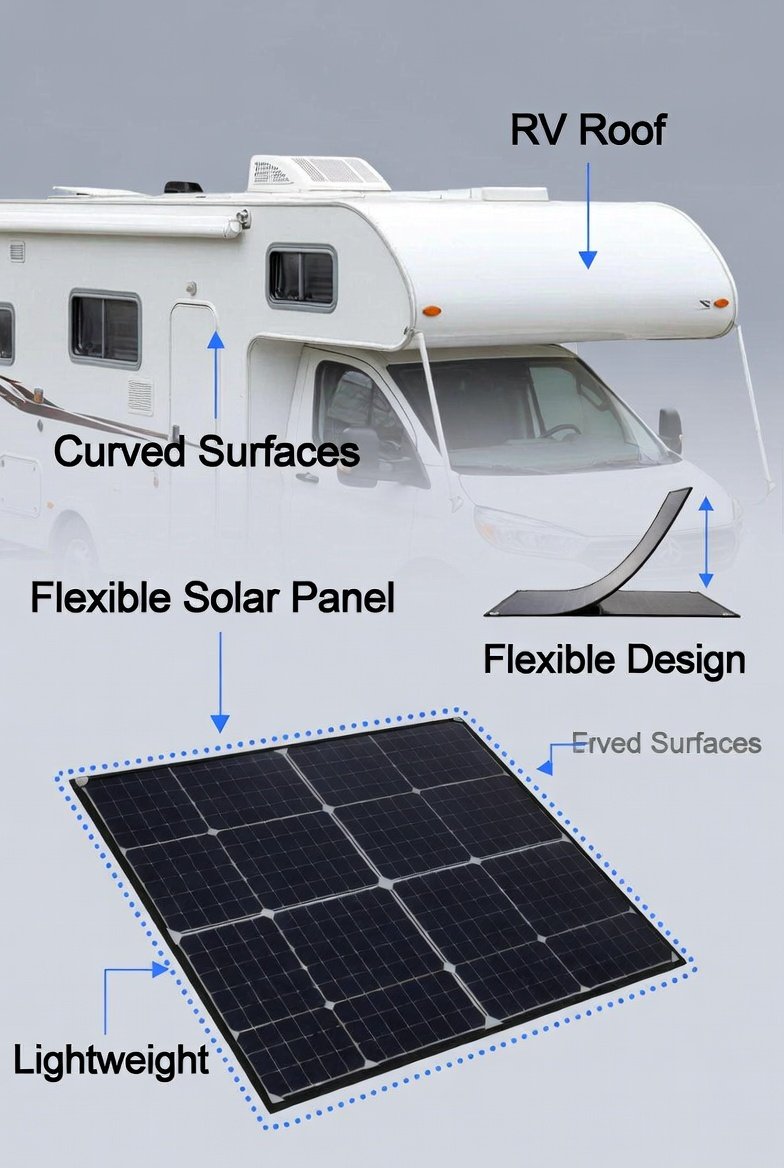
Visual Reference
Typical flexible solar installations include:
- thin panels adhered directly to RV roofs
• marine decks with low-profile solar panels
• curved vehicle roofs where rigid panels cannot mount
These installations highlight the main advantage of flexible panels: surface adaptability.
Flexible Solar Panels vs Rigid Solar Panels
Flexible and rigid solar panels differ in several important ways.
Feature | Flexible Solar Panels | Rigid Solar Panels |
Weight | very lightweight | heavier |
Mounting | adhesive or direct surface mount | brackets or rails |
Surface compatibility | curved surfaces possible | flat surfaces only |
Cooling airflow | limited | better airflow |
Lifespan | shorter | longer |
Efficiency | slightly lower | typically higher |
Rigid panels remain the most durable option for long-term solar installations.
Flexible panels exist primarily to solve installation challenges.
Thermal Performance Reality
Flexible panels often run hotter than rigid panels.
This occurs because rigid panels are typically mounted several inches above the surface, allowing air to circulate underneath.
Flexible panels are usually mounted directly onto roofs or decks.
This direct contact reduces airflow and traps heat.
Higher panel temperatures reduce electrical efficiency and can accelerate long-term wear.
Understanding this thermal behavior helps explain why flexible panels sometimes produce slightly less power than rigid alternatives.
Where Flexible Solar Panels Work Best
Flexible panels are most effective in specific situations.
RV Roof Installations
Many RV roofs are curved or crowded with vents and air conditioners.
Flexible panels can mount directly onto available roof surfaces without requiring brackets.
For traditional roof-mounted panels, see:
Marine Solar Systems
Boat decks and cabins often contain curved fiberglass surfaces.
Flexible panels can adhere directly to these surfaces without heavy mounting hardware.
This makes them popular in marine solar installations.
Van Conversions
Van life builds frequently prioritize lightweight equipment.
Flexible panels help reduce total system weight while maintaining solar generation capability.
Installation Surfaces for Flexible Solar Panels
Flexible solar panels can mount onto several surface types.
Common examples include:
- fiberglass RV roofs
- aluminum vehicle roofs
- marine decks
- camper van tops
Panels are usually installed using marine adhesives or specialized mounting tape designed for outdoor conditions.
Proper installation is important to prevent moisture intrusion or panel damage.
Real-World Limitations of Flexible Solar Panels
Flexible panels offer unique advantages but also introduce several trade-offs.
Shorter Lifespan
Rigid panels can last decades.
Flexible panels typically have shorter service lives due to heat exposure and material stress.
Lower Cooling Efficiency
Because flexible panels sit directly on surfaces, airflow underneath the panel is limited.
This can reduce performance during hot weather.
Limited Curvature
Despite the name, flexible panels cannot bend sharply.
They are designed to follow gentle curves, not extreme bends.
When Flexible Solar Panels Make Sense
Flexible solar panels are ideal when:
- the installation surface is curved
- weight must be minimized
- mounting brackets are impractical
- a low-profile installation is required
In these cases flexible panels may be the only practical solar option.
When Rigid Panels Are Better
Rigid panels remain the better choice when:
- long lifespan is the priority
- maximum power output is needed
- flat mounting surfaces are available
- airflow cooling is important
Rigid panels also perform better in large off-grid solar systems.
Understanding battery capacity also helps determine solar requirements:
battery bank
Monitoring system performance becomes easier with a battery shunt:
battery shunt
Conclusion
Flexible solar panels provide a lightweight and adaptable solar option for installations where rigid panels cannot be mounted easily.
Their thin design allows them to follow curved surfaces on RV roofs, boats, and vans while maintaining a low-profile installation.
However, flexible panels are not universal replacements for rigid solar panels.
They exist to solve specific installation challenges.
If your solar installation surface is curved, lightweight, or difficult to mount, flexible solar panels are often the correct solution.
FAQ
What are flexible solar panels?
Flexible solar panels are thin photovoltaic panels designed to bend slightly and mount directly onto curved or irregular surfaces such as RV roofs, boats, and vans.
Are flexible solar panels less efficient than rigid panels?
Flexible panels are typically slightly less efficient because they run hotter and have less airflow compared to rigid panels.
How long do flexible solar panels last?
Flexible panels usually have shorter lifespans than rigid panels due to heat exposure and material stress.
Can flexible solar panels bend completely?
No. Flexible panels can follow gentle curves but cannot bend sharply.
Are lightweight solar panels good for RV roofs?
Yes. Lightweight flexible panels are commonly used on RV roofs where curved surfaces or weight limits make rigid panels difficult to install.