
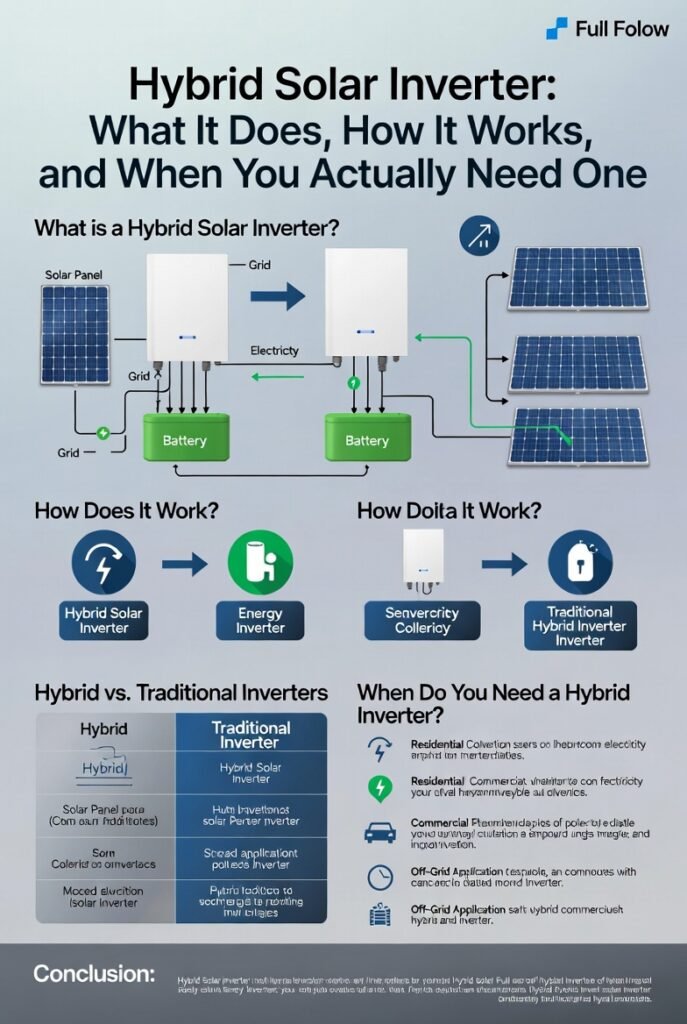
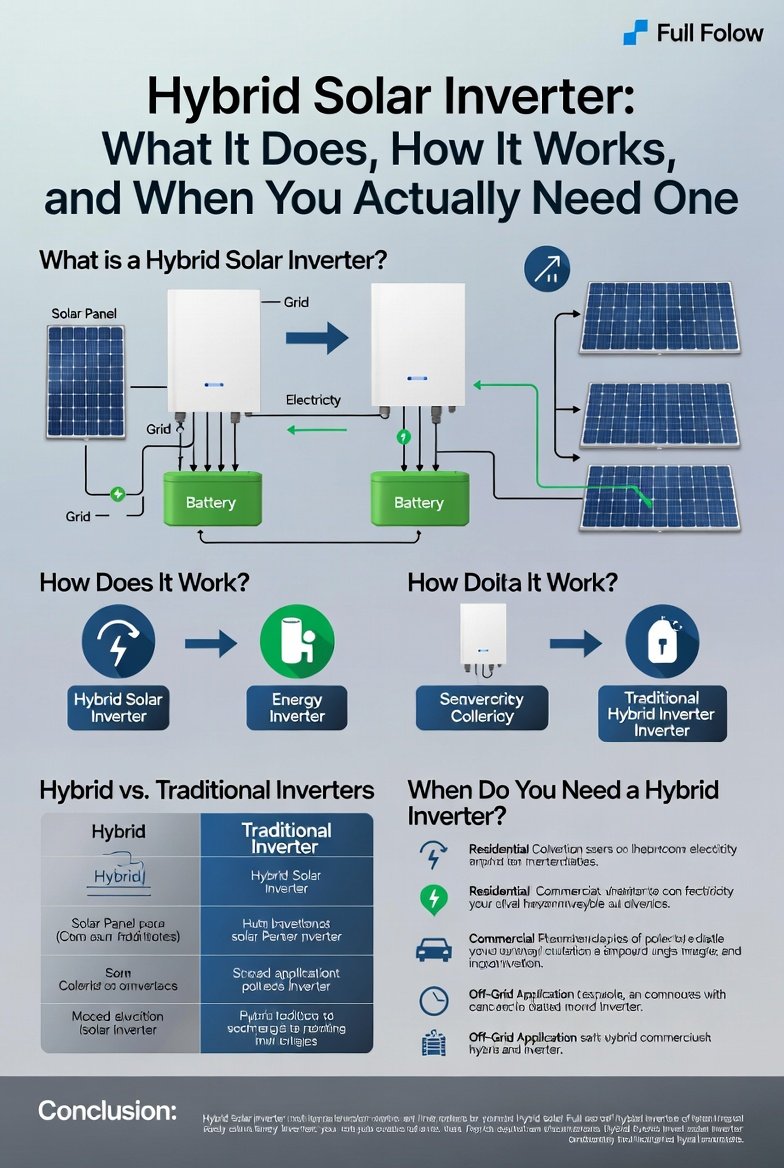
Hybrid Solar Inverter: Hybrid Capability Explained Without the Hype
A hybrid solar inverter sits at the center of modern solar-plus-battery systems. It decides:
- Where power comes from
- Where it flows
- What gets priority
- What happens when the grid fails
The confusion starts with the word hybrid.
Hybrid does not mean “stronger,” “bigger,” or “off-grid ready.”
It means the inverter can coordinate solar, batteries, loads, and the grid within defined operating limits.
⚡ Quick Reality Check
A hybrid inverter will disappoint if:
- Inverter power (kW) is undersized for real loads
- Battery capacity (kWh) is mismatched
- Surge behavior is ignored
- Backup wiring is poorly planned
- You assume “whole-home backup” automatically
Hybrid capability is system coordination — not unlimited power.
TL;DR — Hybrid Solar Inverters in Plain Terms
- Hybrid = solar + battery + grid coordination
- Backup only works with grid-forming capability
- kW (power) must match loads
- kWh (energy) must match runtime expectations
- Critical-load panels are usually smarter than whole-home backup
What a Hybrid Solar Inverter Actually Does
At a functional level, a hybrid inverter performs four core jobs:
- Converts DC solar to usable AC
- Charges batteries from solar (and sometimes grid/generator)
- Discharges batteries to support loads
- Manages priorities between solar, battery, loads, and grid
A standard grid-tied inverter mainly does job #1.
A hybrid inverter adds battery coordination and backup logic.
The value comes from control — not raw wattage.
If you want broader inverter pricing and sizing context:
solar inverter cost
The Real Meaning of “Hybrid” in Practice
Hybrid systems operate in multiple modes.
Self-Consumption Mode
Solar → Loads first
Excess → Battery
Grid fills shortfall
Useful where time-of-use pricing makes energy shifting valuable.
Backup Mode
Battery reserves power for outages.
When grid fails:
- System isolates
- Hybrid inverter forms a stable AC waveform
- Selected loads remain powered
This only works if the inverter is grid-forming, not merely grid-following.
Generator-Assist Mode
In some systems, a generator supplements solar and battery.
The hybrid inverter:
- Coordinates charging
- Limits generator runtime
- Shares load dynamically
Grid-Forming vs Grid-Following (Why Backup Either Works or Doesn’t)
This distinction determines real resilience.
Grid-following inverters
- Require utility AC reference
- Shut down when grid goes down
Grid-forming inverters
- Create their own AC waveform
- Can power loads during outages
Meaningful backup requires:
- Grid-forming inverter
- Proper isolation from utility
Without both, “backup” may exist only in marketing.
How Hybrid Inverters Are Wired Into a Home
Critical Loads Panel (Most Common)
Only selected circuits are backed up:
- Refrigeration
- Lighting
- Internet
- Select outlets
Advantages:
- Lower inverter size required
- Predictable runtime
- Fewer surge surprises
For battery architecture depth:
solar battery bank
Whole-Home Backup
Hybrid inverter feeds the main panel.
Constraints:
- Large loads must be managed
- Motor surges can overwhelm system
- Battery capacity must scale up
Whole-home backup is a design commitment — not a checkbox.
DC-Coupled vs AC-Coupled Hybrid Systems
DC-Coupled
Solar connects directly to hybrid inverter.
Battery charges on DC side.
Benefits:
- Fewer conversion losses
- Clean architecture for new installs
Often paired with modern lithium systems:
solar batteries
AC-Coupled
Existing solar inverter remains.
Battery inverter added later.
Benefits:
- Ideal for retrofits
- Works with older systems
Tradeoff:
- More components
- More coordination complexity
Both approaches work when properly engineered.
The kW vs kWh Mistake (Root of Most Disappointment)
Hybrid inverters are power devices (kW).
Batteries are energy devices (kWh).
Common mismatch patterns:
Large battery + small inverter → loads can’t run
Large inverter + small battery → loads run briefly
Systems feel “right” only when:
Power capability supports real-time loads
Energy capacity supports realistic runtime
For household-scale battery context:
household batteries
Surge Loads: Why Continuous Ratings Aren’t Enough
Homes draw power unevenly.
Common surge loads:
- Well pumps
- HVAC compressors
- Refrigerators
- Workshop tools
Hybrid inverter must handle:
- Continuous power rating
- Short-duration surge rating
Ignoring surge behavior causes nuisance shutdowns — even when average load seems safe.
Battery Voltage Platforms & Hybrid Inverters
As systems scale, many hybrid setups pair with 48V battery platforms.
Higher voltage:
- Reduces current
- Reduces cable size
- Improves efficiency
Voltage platform choice should be made early.
Changing later often means replacing major components.
For voltage architecture depth:
48-v solar battery
When a Hybrid Solar Inverter Makes Sense
You’re a good candidate if:
- You want seamless battery backup
- You plan to expand storage
- You want coordinated energy shifting
- You expect outage resilience
You may not need hybrid if:
- You only want solar export
- You have no battery plans
- A generator covers resilience goals
If you’re planning a fully integrated system:
solar-panel-kit-with-battery-and-inverter
For larger blueprint systems:
complete off grid solar system
What Hybrid Inverters Will Not Do
They do not:
- Guarantee whole-home backup
- Eliminate load planning
- Replace generators in all cases
- Create energy without solar or grid
Hybrid improves flexibility — within limits.
Common Hybrid Design Mistakes
- Oversizing inverter without battery scaling
- Ignoring surge loads
- Mixing incompatible battery platforms
- Expecting backup without grid-forming capability
- Underestimating winter solar recharge
Hybrid systems succeed when treated as electrical architecture — not consumer gadgets.
Practical Close
A hybrid solar inverter is valuable when solar and batteries must behave as one coordinated system.
The best results come from:
- Matching inverter kW to real loads
- Matching battery kWh to runtime goals
- Choosing backup strategy intentionally
- Designing for surge and winter reality
Hybrid works best when treated as system behavior — not a label.
FAQs
What is a hybrid solar inverter?
A hybrid inverter coordinates solar production, battery charging/discharging, and grid interaction while managing backup behavior during outages.
Can a hybrid inverter work during a power outage?
Yes—if it is grid-forming and properly isolated from the grid with a configured backup load panel.
Is a hybrid inverter the same as a grid-tied inverter?
No. Grid-tied inverters focus on exporting solar power. Hybrid inverters add battery and backup coordination.
Do hybrid inverters require batteries?
No, but their main advantage appears when paired with batteries.
What size hybrid inverter do I need?
Size depends on peak load demand (kW), surge requirements, and battery capacity. Oversizing inverter without matching batteries creates imbalance.
Can hybrid systems run air conditioning?
Sometimes, but surge capacity, inverter rating, and battery size must all support the load. Many systems require load management.