
400 Watt Solar Panels: What the Size Really Means in a Real Solar System
A 400 watt solar panel sounds simple.
It looks like a single number.
A single output rating.
A single buying decision.
In practice, it is not that simple.
A 400 watt panel is not defined only by wattage. It is also defined by its voltage class, physical size, current output, weight, and how it fits into the rest of the solar system.
That is why two panels with the same 400W label can behave differently in real installations. Product spec pages for 400W modules show meaningful variation in dimensions, weight, and electrical characteristics such as Vmp and Voc.
That distinction matters.
A 400 watt panel may be a very good fit for a cabin roof, a residential system, or a larger RV build. But in some systems it can also be the wrong choice because the panel is physically large, electrically mismatched to the controller, or simply harder to mount than two smaller panels.
Typical 400W module specs often place them in a larger, residential-style format, and many are substantially bigger than the compact RV-oriented panels people are used to.
So the real question is not just:
“How many watts is it?”
The real question is:
“What does a 400 watt panel mean inside an actual solar system?”
Short Answer
A 400 watt solar panel is a solar module rated to produce 400 watts under Standard Test Conditions (STC), not necessarily in everyday field conditions.
In real use, output depends on:
sunlight hours
temperature
wiring losses
system design
Most 400W panels are physically large, often use higher-voltage electrical characteristics than small RV panels, and usually work best with MPPT charge controllers rather than simple PWM setups.
What “400 Watts” Actually Means
The 400W label is a lab-rated maximum output, usually measured under Standard Test Conditions.
Those test conditions assume:
strong sunlight
a fixed panel temperature
controlled test settings
This means a 400 watt panel does not produce 400 watts all day in normal use.
Real-world output is lower because:
temperature rises
sun angle changes
weather conditions vary
system losses occur
So when someone says “this is a 400 watt panel,” what they really mean is:
This panel can reach 400 watts under ideal standardized conditions.
That number is useful for comparing panels, but it is not a guarantee of real-world output.
A 400W Panel Is More Than a Wattage Number
A common mistake buyers make is thinking a 400 watt panel simply means more power.
In reality, it also defines an electrical format.
Real product datasheets list specifications like:
Vmp — voltage at maximum power
Voc — open circuit voltage
Imp — current at maximum power
Isc — short circuit current
These values vary across real 400W modules.
Some panels operate around the low-30V range, while others are higher-voltage residential-style modules with Voc values above 40V.
That matters because a solar panel never works alone. It must match:
the charge controller
the battery bank voltage
the inverter strategy
the panel string layout
For a full system overview see:
best-off-grid-solar-system
Why Voltage Class Matters More Than Most Buyers Realize
Many beginners think:
“I have a 12V battery system, so I need a 12V panel.”
But that logic often breaks down with 400W panels.
Many 400W panels are actually higher-voltage modules designed to work with a charge controller (usually MPPT) that converts higher panel voltage into usable battery charging current.
That is why many 400W modules are closer to 24V-class or residential-style panels rather than small beginner panels.
This does not make them bad.
It simply means controller selection becomes more important.
For controller details see:
mppt-solar-charge-controller
How Much Power a 400 Watt Solar Panel Produces in Real Conditions
Real solar production is better measured as daily energy, not peak watts.
A practical field formula is:
Daily Wh ≈ Panel Watts × Peak Sun Hours × 0.7–0.8
The loss factor accounts for:
heat losses
wiring loss
controller inefficiency
imperfect panel angle
dirt and other system losses
Typical Daily Output Examples
If a location receives 4 peak sun hours
400 × 4 × 0.75 = 1,200 Wh/day
If a location receives 5 peak sun hours
400 × 5 × 0.75 = 1,500 Wh/day
If a location receives 6 peak sun hours
400 × 6 × 0.75 = 1,800 Wh/day
So in real conditions a 400W panel often produces around:
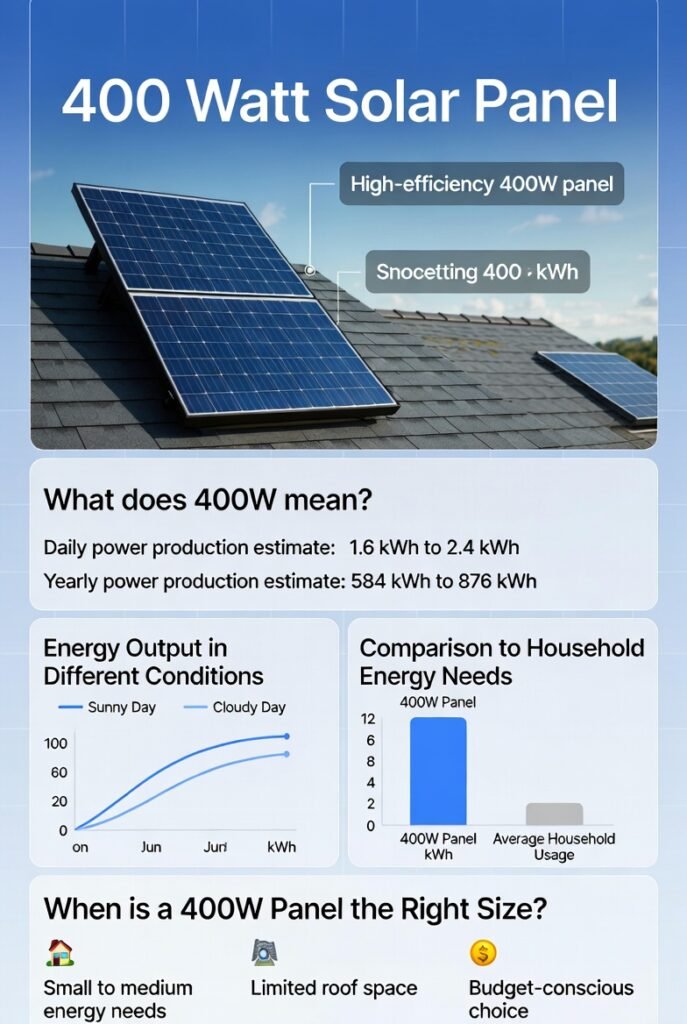
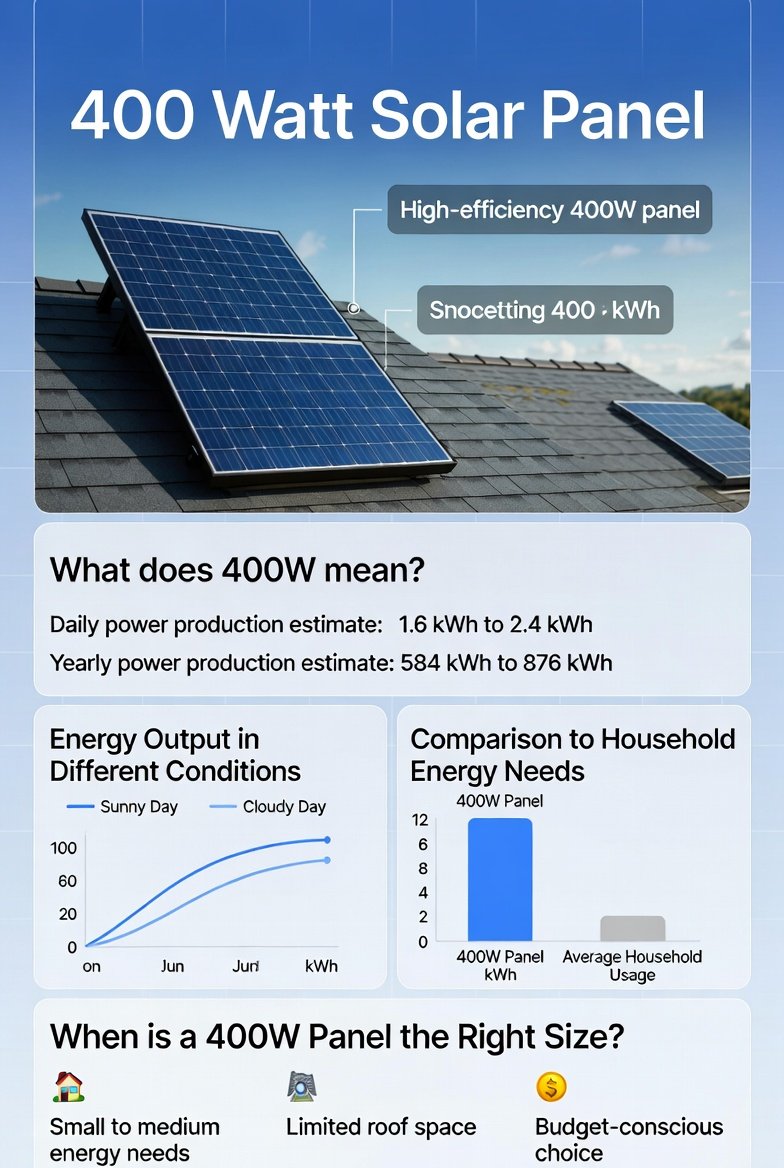
1.2 – 1.8 kWh per day
depending on sunlight and system design.
How Many Amps Does a 400W Panel Produce?
This depends on where the current is measured.
Panel Side
Most 400W panels produce low-teens amps at their operating voltage.
Battery Side (Through MPPT)
If charging a 12V battery system, current increases because MPPT converts voltage into current.
Example calculation:
400W ÷ 14V ≈ 28 amps (before losses)
After losses the real value may be slightly lower.
That is why people often confuse:
panel amps
battery charging amps
They are not the same thing.
Physical Size and Handling Reality
Another important factor is panel size.
Many 400W modules are large residential-style panels.
Typical characteristics:
significantly larger than RV panels
weight around 40–45 pounds
large surface area
Practical consequences include:
may not fit around RV vents or AC units
harder for one person to install
fewer panels but larger size
transportation challenges
Sometimes two smaller panels fit better than one large 400W panel.
For RV installations see:
rv-solar-panels
When 400 Watt Solar Panels Make Sense
A 400W panel works well when:
1. Roof or rack space is open
Large flat surfaces make installation easier.
2. You want fewer panels
Higher wattage means fewer modules.
3. You are using MPPT
Higher voltage panels pair well with MPPT controllers.
4. You are building a cabin or off-grid system
Larger panels reduce system complexity.
5. You are installing a home solar system
400W panels are common in residential setups.
When 400 Watt Panels Are the Wrong Choice
They may not be ideal when:
Tight RV roofs
Obstructions make large panels hard to install.
Beginner PWM systems
Some 400W panels are not optimized for basic controllers.
One-person installation
Large panels are harder to lift.
Portable solar systems
Rigid 400W panels are usually not portable-friendly.
For portable setups see:
portable-solar-panel-kit
400W Panels and Charge Controller Matching
Before installing a 400W panel you must verify:
panel Voc
controller maximum PV input voltage
battery bank voltage
cold-weather voltage increase
Manufacturers include these specs because proper matching is essential.
Practical rule
Always check:
panel Voc
controller maximum PV voltage
cold weather voltage margin
Many systems using 400W panels work best with MPPT controllers with sufficient voltage headroom.
What a 400 Watt Panel Can Actually Run
A 400W panel should be viewed as an energy source, not a direct appliance guarantee.
In good sun it can help power:
battery charging
lighting
fans
laptops
small electronics
part of a refrigerator’s energy use
But it cannot run an entire house by itself.
Battery storage and inverter size are equally important.
For battery planning see:
solar-battery-bank
Why 400W Became a Popular Panel Size
The 400W class sits in a useful middle range.
It offers:
strong power output
reasonable panel count
efficient roof use
simpler wiring
This balance is why many residential systems today use panels around this size.
Decision Summary
A 400 watt solar panel is not simply a bigger panel.
It is a specific electrical and physical panel class.
It works best when:
the roof can fit large panels
the charge controller is correctly matched
MPPT is used where appropriate
the rest of the system is designed around its voltage and size
If you only look at wattage, you might choose the wrong panel.
If you consider wattage, voltage, controller compatibility, and physical fit, choosing the right panel becomes much easier.
FAQ
What does 400 watts mean on a solar panel?
It means the panel is rated to produce 400 watts under Standard Test Conditions. Real output depends on sunlight, temperature, and system losses.