
MPPT Solar Charge Controller: A Practical Guide for Real Solar Systems
An MPPT solar charge controller looks optional on paper.
In real systems, it quietly becomes the difference between:
- A battery that reaches full charge cleanly
- A system that constantly underperforms
- Or worse — a controller that fails from improper sizing
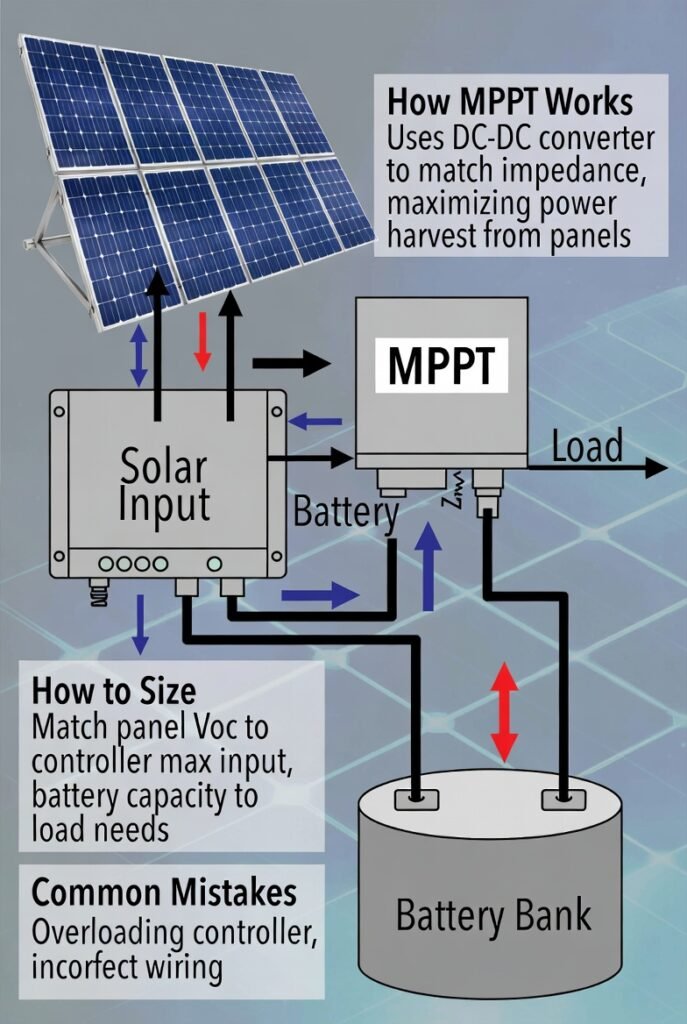
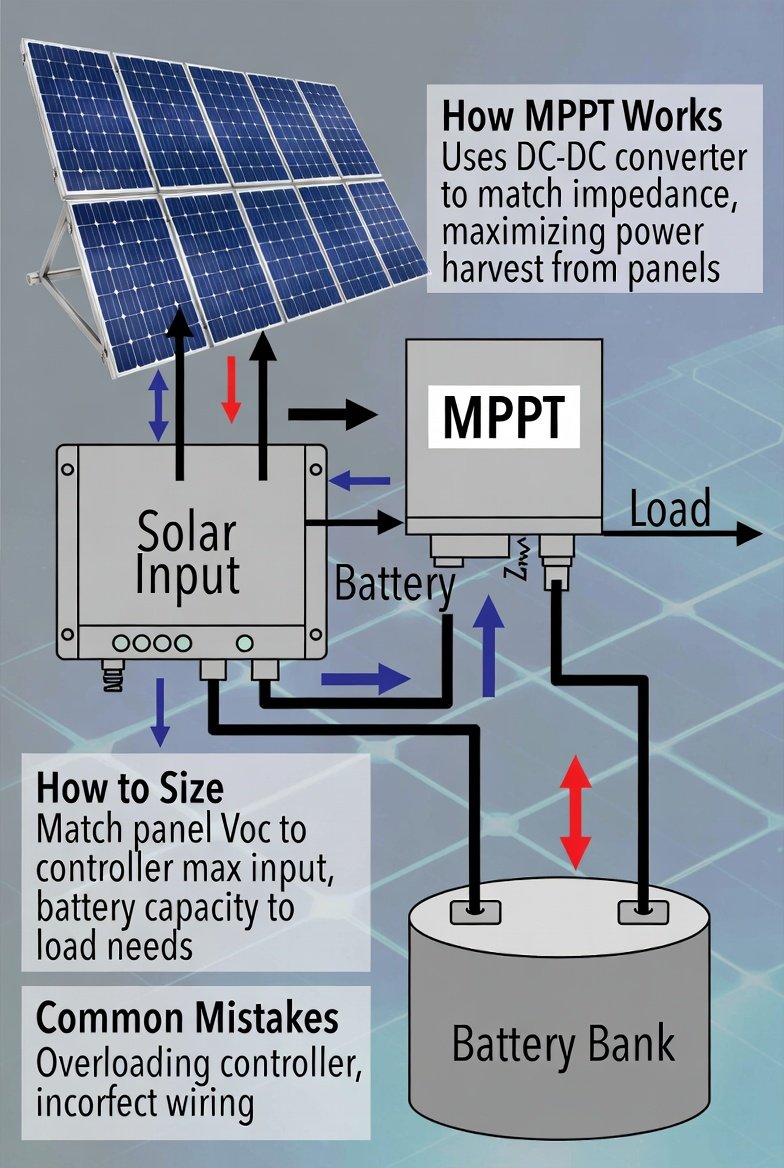
At its core, an MPPT (Maximum Power Point Tracking) controller is a DC-to-DC power converter. It allows solar panels to operate where they produce maximum power, then converts that power into the correct voltage and current for safe battery charging.
But most MPPT failures don’t happen because the controller is bad.
They happen because:
- Voltage limits were ignored
- Cold weather margins were not calculated
- Output current was misjudged
- Wiring was undersized
This guide explains MPPT behavior, sizing logic, and common mistakes — without drifting into full system blueprints or product roundups.
⚡ Quick Reality Check
An MPPT controller will fail if:
- Your cold-weather Voc exceeds its input limit
- You size by watts only
- You mismatch battery voltage and controller output
- You copy lead-acid settings onto lithium
Voltage limits are not suggestions.
They are hard boundaries.
TL;DR — MPPT in Plain English
- MPPT extracts more usable power when array voltage exceeds battery voltage
- Voltage (Voc) limit matters more than wattage
- Cold weather increases panel voltage
- Higher battery voltages scale more cleanly
- Most controller “failures” are setup errors
What a Solar Charge Controller Does (Before MPPT Matters)
Every charge controller exists to:
- Prevent battery overcharge
- Deliver energy in controlled stages
Typical charging stages:
- Bulk (maximum current)
- Absorption (voltage held constant)
- Float (maintenance charge)
MPPT does not replace this staged charging behavior.
It improves how much usable power reaches those stages in the first place.
Battery architecture context:
solar bank
Voltage platform scaling:
48v- solar batteries
MPPT vs PWM: The Real Difference
PWM controllers force the solar array to operate near battery voltage. Excess panel voltage is wasted.
MPPT controllers allow the array to operate at higher voltage and convert that power down efficiently.
Quick Comparison
Feature | PWM | MPPT |
Panel voltage behavior | Forced to battery voltage | Tracks max power point |
Efficiency in mismatch | Lower | Higher |
Best for | Small 12V systems | Series arrays, 24V/48V systems |
Cold weather benefit | Minimal | Stronger |
Cost | Lower | Higher |
MPPT becomes increasingly valuable as:
- Array voltage rises
- Wire runs lengthen
- Battery voltage increases
- Systems scale
Why MPPT Harvests More in Cold Weather
Panel voltage rises as temperature drops.
Higher voltage above battery level gives MPPT more conversion headroom.
Cold climates amplify MPPT benefits — but they also amplify risk.
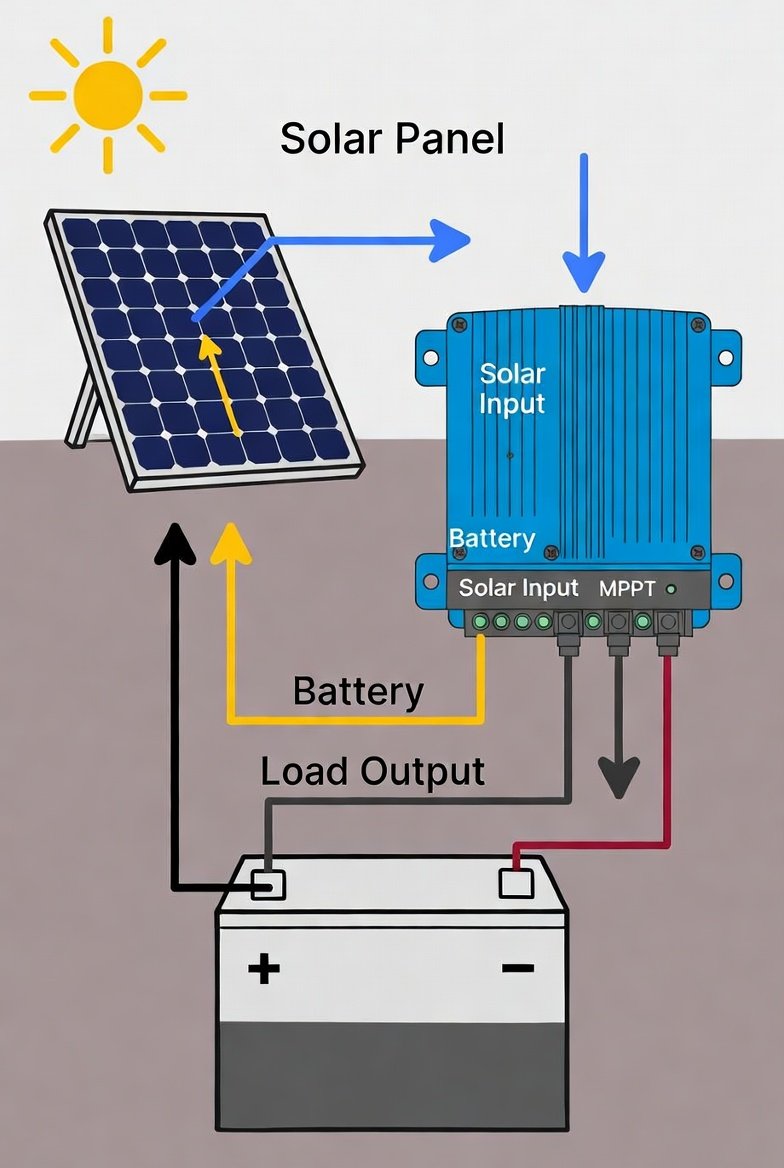
The Point of No Return: Cold Voc Damage
Here is the failure moment most installers miss:
Cold morning.
Bright sun.
Panels at lowest temperature of the year.
Voc spikes.
If your panel string exceeds controller maximum input voltage — even briefly — internal components can be permanently damaged.
This is not a gradual degradation.
It is often instant.
Cold Voc miscalculation is the #1 cause of MPPT failure.
The Two Limits That Actually Matter
Most people size by watts.
Watts are incomplete.
You must respect:
1) Maximum PV Input Voltage (Voc Limit)
Calculate series Voc.
Apply conservative cold margin.
Stay below controller rating.
If this rule is violated, nothing else matters.
2) Maximum PV Input Current (Isc Limit)
Parallel strings increase current.
If current exceeds input rating:
- Overheating
- Internal stress
- Premature failure
Controllers protect themselves imperfectly.
Don’t rely on protection as design.
A Sizing Example That Actually Works
Example system:
Two panels rated:
- Voc = 40V
- Isc = 11A
Wired in series:
Voc = 80V
Apply 20% cold margin:
80V × 1.2 = 96V
If controller limit = 100V → safe but tight
If controller limit = 150V → comfortable
Now output current sizing:
Array = 800W
Battery = 24V
Charge current ≈ 800W ÷ 28V (absorption voltage) ≈ 28A
Choose a controller rated ≥ 40A for margin.
This is real sizing.
Not guessing by watt label.
Series vs Parallel: Why MPPT Expands Options
MPPT allows higher array voltage.
Higher voltage means:
- Lower current on PV wiring
- Reduced voltage drop
- Cleaner layout
- Fewer parallel strings
But higher voltage also means:
- Proper disconnects required
- Fusing becomes critical
- Safety awareness increases
MPPT increases flexibility — not forgiveness.
Charging Stages: What You’re Actually Configuring
Most MPPT controllers allow adjustment of:
- Absorption voltage
- Absorption duration
- Float voltage
- Equalization (lead-acid only)
- Temperature compensation
Lithium batteries often require:
- No equalization
- Limited or no float
- Precise absorption termination
Lithium framing:
lithium solar batteries
The controller must match the battery.
Not the other way around.
Common MPPT Myths (That Cause Real Problems)
“MPPT always gives 30% more power.”
Not always. Gains depend on voltage mismatch and conditions.
“More watts is always better.”
Only if voltage and current limits are respected.
“The controller will protect itself.”
Protection is not a design strategy.
“Voltage drop doesn’t matter in DC.”
It absolutely does, especially at low battery voltages.
“PWM is useless.”
PWM works fine in small 12V systems with matched voltage.
When MPPT Is Worth It
MPPT is typically justified when:
- Arrays use series wiring
- Battery system is 24V or 48V
- Wire runs are long
- Cold climate operation
- Expansion plans exist
Hybrid system context:
hybrid solar inverter
Grid-only boundary:
Full system packages:
solar-panel-kit-with-battery-and-inverter
Pricing boundary:
solar cost
Complete system blueprint:
off-grid solar system
Installation Mistakes That Kill Controllers
- Exceeding cold Voc limit
- Undersized battery cables
- No PV disconnect
- No overcurrent protection
- Misconfigured lithium profile
- Poor grounding assumptions
Most “defective controller” stories trace back to one of these.
Scope Boundary (Anti-Cannibal)
This page owns:
- MPPT behavior
- MPPT vs PWM boundary
- Voc/Isc sizing logic
- Charging stage configuration
- Installation pitfalls
It does NOT cover:
- Full inverter selection
- Complete battery bank design
- Product roundups
- Cost comparisons
Clean silos = stronger topical authority.
Practical Close
An MPPT solar charge controller is not just a regulator.
It is a power conversion device that allows solar panels to operate where they perform best and translates that energy into controlled battery charging.
When voltage limits, current limits, and battery profiles are respected, MPPT controllers are among the most reliable components in a solar system.
When those limits are ignored, the controller becomes the scapegoat for design mistakes elsewhere.
FAQs
What does an MPPT solar charge controller do?
It tracks the panel’s maximum power point and converts that energy into the correct voltage and current needed to charge batteries efficiently and safely.
Is MPPT better than PWM?
Often yes, especially when array voltage exceeds battery voltage, in cold climates, or in larger 24V/48V systems.
What happens if PV voltage exceeds the controller limit?
Exceeding maximum input voltage can permanently damage the controller, especially during cold-weather voltage spikes.
Can MPPT charge lithium batteries?
Yes, but charging parameters must match lithium requirements, including disabling equalization and adjusting float behavior.
How do I size an MPPT controller?
Ensure cold-adjusted Voc stays below the controller limit, respect Isc input limits, and size output current based on battery voltage and array wattage.
Do I need multiple MPPT controllers?
Sometimes. Large or differently oriented arrays may benefit from multiple trackers.