
Battery Monitor With Shunt: How It Works and Why Solar Systems Use It
A solar power system can generate electricity, store energy, and run electrical loads.
But without accurate monitoring, it is difficult to know how much energy remains available inside the battery bank.
A battery monitor with shunt solves this problem by measuring every amp flowing into and out of the battery.
Instead of estimating battery charge using voltage alone, a shunt-based monitor calculates the actual energy moving through the system.
In practice, the device becomes the energy accounting point of the entire electrical system.
This is especially important in modern lithium battery installations where voltage readings alone provide very little information about remaining battery capacity.
Short Answer
A battery monitor with shunt measures every amp entering and leaving the battery, allowing it to calculate remaining battery capacity accurately.
Because lithium batteries maintain nearly constant voltage during discharge, current-tracking through a shunt is the only reliable way to monitor real state of charge in off-grid and RV solar systems.
Where a Battery Monitor Fits in a Solar Power System
A typical off-grid solar system follows this energy flow:
Solar panels
↓
MPPT charge controller
↓
Battery bank
↓
Inverter
↓
Electrical loads
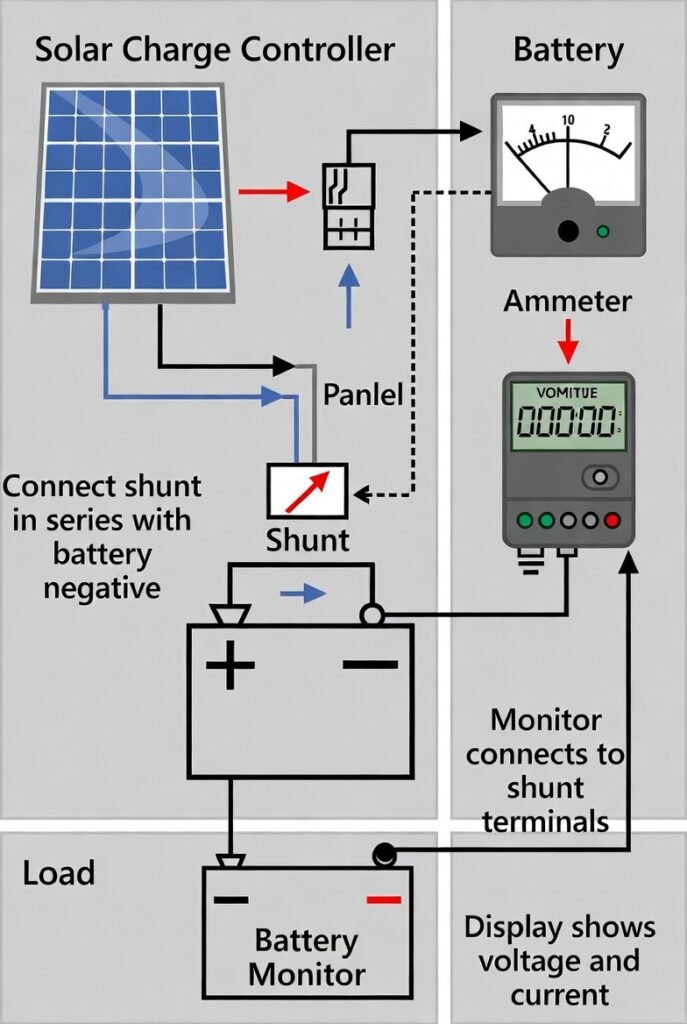
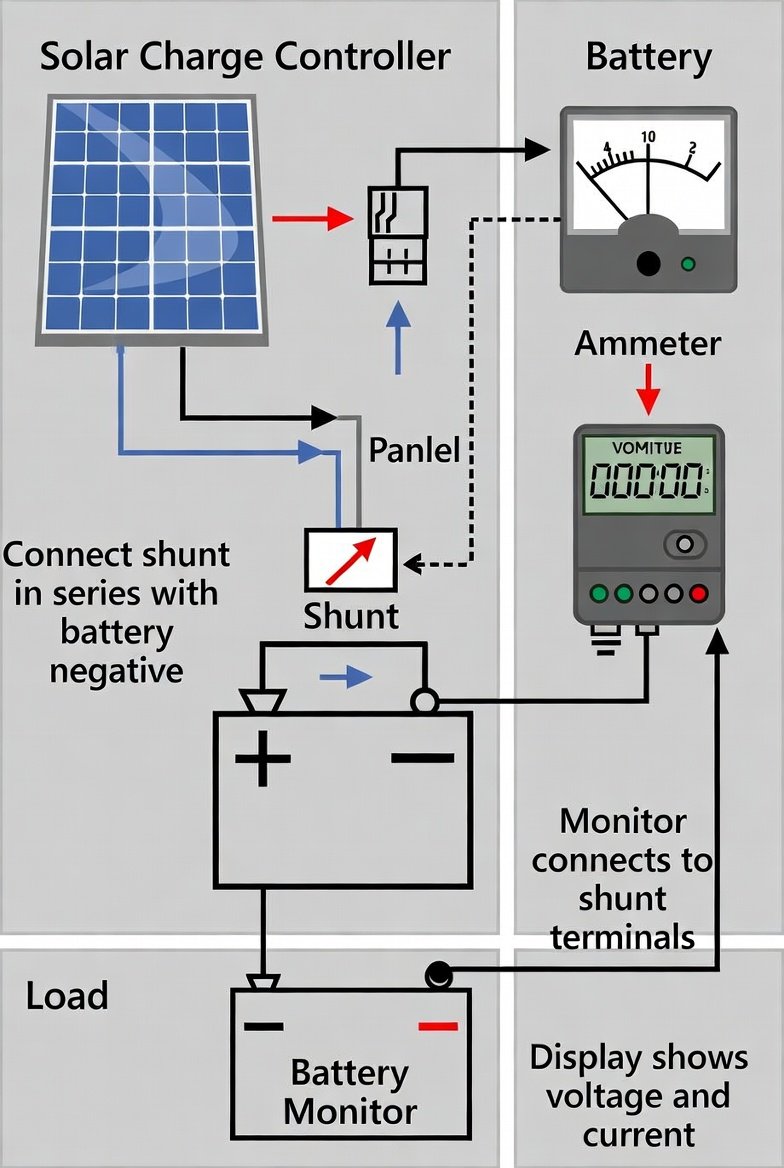
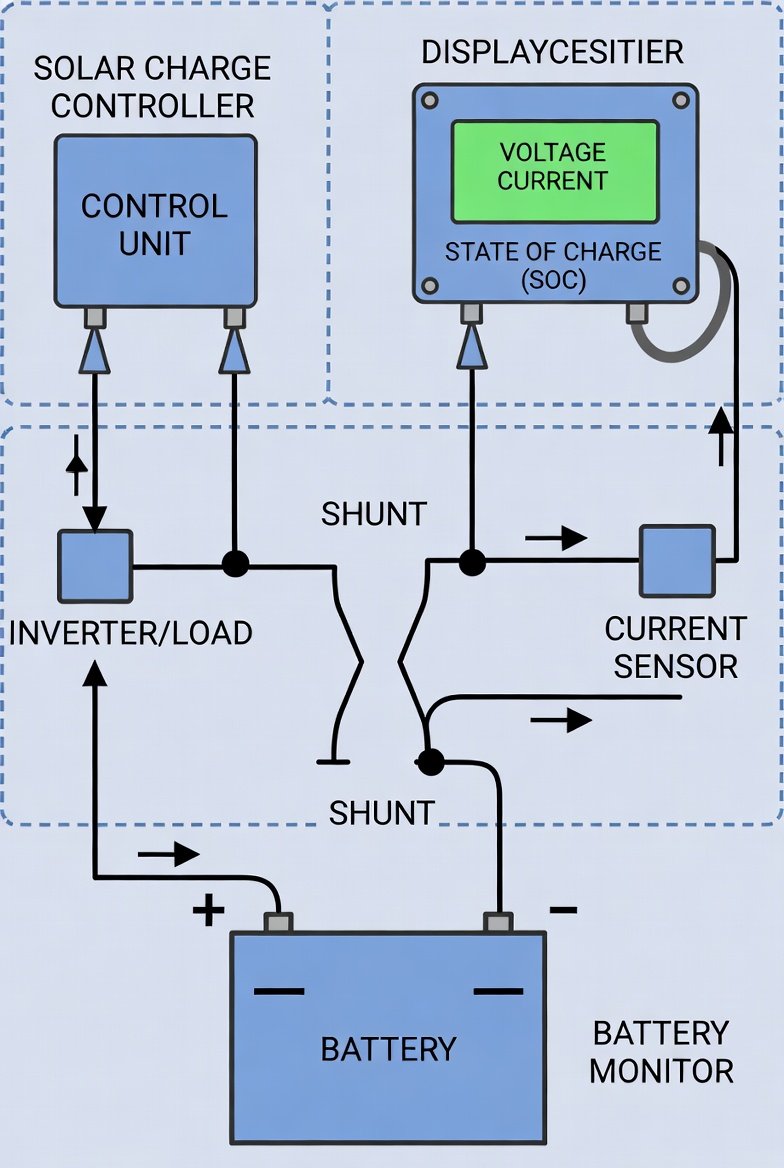
A battery monitor with shunt sits at the battery negative connection, measuring all current flowing into and out of the battery bank.
Because every electrical path passes through this point, the monitor becomes the measurement center of the entire DC system.
For a deeper overview of how full systems are designed, see the guide to
best off grid solar system
What a Shunt Actually Measures
A shunt is a precision resistor installed in the battery negative cable.
When electrical current passes through the resistor, a tiny voltage drop occurs.
The battery monitor measures that drop and converts it into current flow.
Because every load and charger passes through the shunt, the monitor can measure:
- charging current
• discharging current
• total amp-hours used
• total amp-hours stored
• estimated battery state of charge
This method is called coulomb counting, which tracks electrical charge moving through the battery bank.
Unlike voltage-based systems, coulomb counting provides an accurate picture of energy usage.
Why Voltage Cannot Accurately Measure Lithium Battery Charge
Many simple battery monitors rely on voltage to estimate battery charge.
This works moderately well for lead-acid batteries when they are resting.
However lithium batteries behave differently.
Lithium iron phosphate batteries maintain nearly constant voltage across most of their discharge range.
A lithium battery might show almost the same voltage at:
80% charge
50% charge
30% charge
Because of this flat voltage curve, voltage readings cannot reliably estimate remaining energy.
This is why lithium systems rely on current-based monitoring using shunts.
If you’re designing lithium systems, understanding storage capacity is critical. The guide to
solar battery bank explains battery bank sizing and system capacity planning.
Voltage Monitoring vs Shunt Monitoring
| Feature | Voltage-Only Monitoring | Shunt Battery Monitor |
| Accuracy | Low | High |
| Lithium Compatibility | Poor | Excellent |
| Tracks Usage | No | Yes |
| SOC Drift | High | Low |
| Off-Grid Use | Limited | Ideal |
Voltage monitors provide rough estimates.
Shunt monitors track actual energy movement, which makes them suitable for serious solar installations.
How a Battery Monitor Calculates State of Charge
Battery monitors calculate remaining capacity using a simple principle:
Energy entering the battery
minus
Energy leaving the battery
equals
Energy remaining.
Example:
Battery capacity: 200Ah
If the system consumes 60Ah overnight, the monitor calculates:
200Ah − 60Ah = 140Ah remaining.
The monitor then converts this information into practical metrics such as:
- battery percentage remaining
• watts currently consumed
• watts entering from solar charging
• estimated runtime remaining
This information allows system owners to manage energy consumption more effectively.
The One Wiring Rule That Determines Accuracy
A battery monitor is only accurate if every amp passes through the shunt.
Correct configuration looks like this:
Battery negative
↓
Shunt
↓
System negative busbar
↓
All loads and chargers
This means:
- inverter negative connects after the shunt
• solar charge controller negative connects after the shunt
• DC loads connect after the shunt
• alternator or DC-DC chargers connect after the shunt
If even one electrical device bypasses the shunt, the monitor cannot measure that current.
Every amp must pass through the shunt.
Understanding how solar charging current enters the battery bank is explained in
Correct vs Incorrect Wiring
❌ Incorrect
Inverter negative connected directly to battery.
The monitor cannot see that current.
SOC calculations become inaccurate.
✅ Correct
Battery negative → shunt → system busbar.
All loads and chargers connect to the busbar.
This ensures the monitor measures the entire system.
Common Installation Mistakes
Several wiring mistakes frequently cause inaccurate readings.
Inverter bypassing the shunt
Large inverters draw high current.
If connected directly to battery negative, the monitor cannot track the load.
Charge controller connected to battery
Charging current bypasses monitoring.
Vehicle chassis grounds
RV electrical systems sometimes bypass the shunt unintentionally.
Multiple negative busbars
Systems must have one negative measurement point.
Safety Note
Battery systems can deliver extremely high fault currents.
Always disconnect all power sources and follow manufacturer torque, fuse, and cable guidelines when installing a shunt monitor.
SOC Drift and Calibration
Battery monitors occasionally show incorrect state of charge when internal calculations drift.
This can happen when:
- batteries never reach full charge
• battery capacity settings are incorrect
• charging cycles remain partial for long periods
Most monitors automatically recalibrate when a full charge condition occurs.
Battery Monitor vs Battery Management System
Lithium batteries often include an internal Battery Management System (BMS).
However a BMS does not replace a battery monitor.
Function | BMS | Battery Monitor |
Protect battery cells | Yes | No |
Prevent over-voltage | Yes | No |
Prevent over-current | Yes | No |
Track energy usage | No | Yes |
Calculate SOC | Limited | Yes |
The BMS protects the battery.
The monitor measures system energy flow.
Common Battery Monitors That Use Shunts
Several well-known monitoring systems use shunt-based measurement.
Examples include:
- Victron SmartShunt / BMV series
• Renogy battery monitors
• Bluetooth shunt monitors used in RV electrical systems
These monitors differ mainly in display features, connectivity, and integration with solar ecosystems.
Choosing the Correct Shunt Rating
Shunts are rated by maximum current capacity.
Typical ratings include:
300A
500A
1000A
Example:
A 2000-watt inverter on a 12-volt system can draw about 167 amps.
Most installations use a 500-amp shunt to handle surge loads safely.
Systems using hybrid inverters may require higher capacity monitors. Hybrid inverter architectures are explained in
hybrid solar inverter
Grid-connected solar systems sometimes use different monitoring strategies described in
When a Solar System Actually Needs a Battery Monitor
Battery monitors are especially useful in several scenarios.
Off-grid homes
Energy availability must be managed carefully during cloudy weather.
RV solar systems
Battery capacity is limited and power consumption must be tracked.
Lithium battery banks
Voltage readings do not accurately indicate remaining capacity.
Backup power systems
Battery monitoring prevents unexpected power loss during outages.
When You Probably Do NOT Need a Battery Monitor
Some simple systems operate fine without advanced monitoring.
Examples include:
Small weekend solar kits
Single lead-acid battery systems
Very low power setups with minimal daily discharge
In these cases voltage monitoring may be sufficient.
What a Battery Monitor Cannot Do
Battery monitors measure energy flow but cannot:
- repair damaged batteries
• measure internal battery cell health
• detect aging cells automatically
• replace a BMS
They simply measure energy movement within the system.
Practical Example: RV Solar Monitoring
Example system:
400W solar array
40A MPPT controller
200Ah lithium battery
2000W inverter
Without a monitor, the owner only sees battery voltage.
With a shunt monitor, the system displays:
- battery percentage remaining
• solar charging power
• load power consumption
• estimated runtime remaining
This information makes energy management far easier during off-grid travel.
Final Perspective
In modern solar systems, energy production matters—but energy awareness is what prevents failure.
A battery monitor with shunt turns a solar installation from a guess-based system into a measurable energy system.
For off-grid homes, RV solar setups, and backup power systems, that visibility often becomes essential.