
550 Watt Solar Panel: Specs, Output Reality, and Where This Panel Class Actually Belongs
A 550W panel isn’t just “a bigger panel.”
It’s usually a large-format module class with a different set of constraints:
- physical size and handling change how you mount it
- panel voltage changes what controllers it can safely use
- stringing becomes more sensitive to cold-weather voltage and controller limits
- roof layout becomes a bigger limiting factor than watts
So instead of treating 550W as a “power upgrade,” treat it as a design choice.
Spec Snapshot (What Most 550W Panels Look Like in Practice)
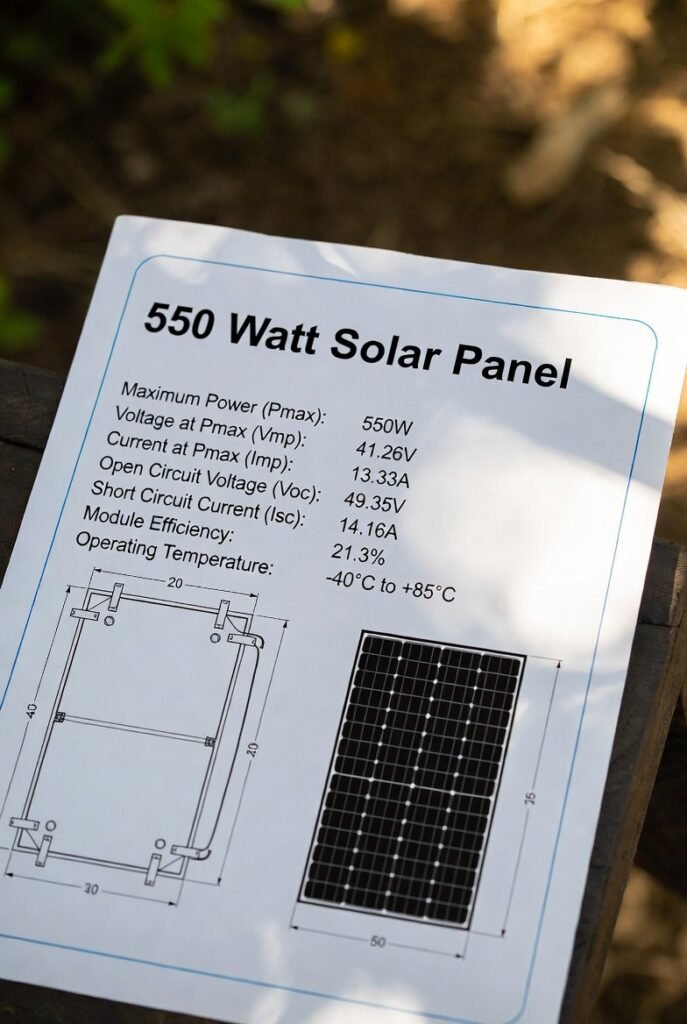
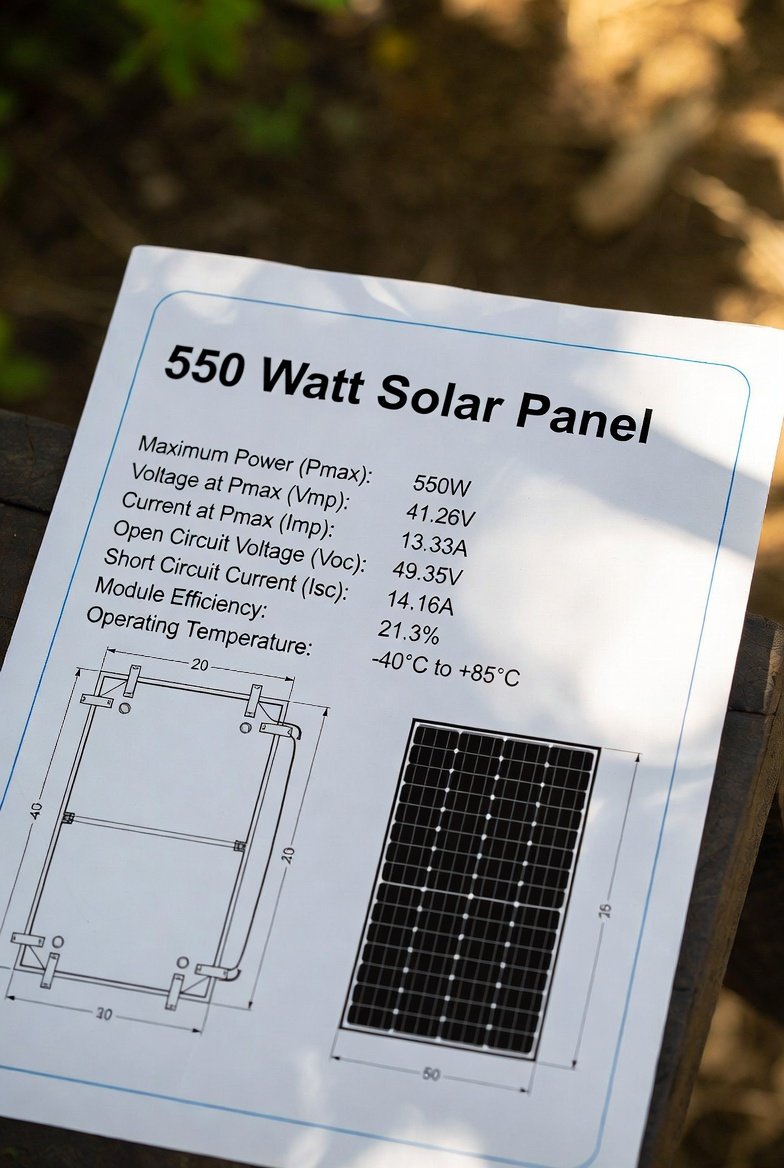
Most 550W panels you’ll see in the market generally land in this neighborhood (varies by model):
- Physical size: large, residential/commercial format
- Weight: heavier than RV-style panels
- Operating voltage (Vmp): typically higher-voltage class
- Open-circuit voltage (Voc): high enough that controller headroom matters
- Operating current (Imp): usually in the low-to-mid teens of amps at the panel
This matters because system compatibility is driven more by voltage + size than by wattage alone.
The One Line That Makes 550W Make Sense (Daily Energy Math)
If you only remember one sizing method, use this:
Daily Wh ≈ Panel Watts × Peak Sun Hours × 0.7–0.8
That loss factor covers heat, wiring, controller efficiency, and real angles.
Real-world daily energy (single 550W panel)
- 4 sun hours: 550 × 4 × 0.75 ≈ 1.65 kWh/day
- 5 sun hours: 550 × 5 × 0.75 ≈ 2.06 kWh/day
- 6 sun hours: 550 × 6 × 0.75 ≈ 2.48 kWh/day
So a single 550W module is commonly a ~1.6 to 2.5 kWh/day contributor in decent conditions.
If you want system-level context (panels → controller → battery → inverter → loads), see:
Why “How Many Amps?” Is a Trick Question
A 550W panel can be described in two different amp numbers:
1) Panel-side amps (what the panel produces at its own voltage)
This is tied to Imp on the spec sheet and often sits in the teens of amps.
2) Battery-side charging amps (after MPPT conversion)
If an MPPT controller converts higher panel voltage into battery charging current:
- At a charging battery voltage of ~14V (12V system charging):
550W ÷ 14V ≈ 39A (before losses)
That does not mean the panel itself is producing 39 amps.
It means the controller is converting voltage into usable charging current.
This distinction is the difference between a clean build and a confusing one.
For controller behavior and why MPPT matters on higher-voltage panels:
The Real Issue With 550W Panels: Controller Voltage Headroom
This is where most DIY builds break.
A 550W panel class tends to have higher Voc, and Voc rises in cold weather.
So the correct design mindset is:
You don’t string panels until you confirm controller max PV voltage and cold-voltage headroom.
Practical rule (no drama, just safe planning)
Before you commit, verify:
- panel Voc
- controller max PV input voltage
- your string count (series panels)
- your cold-weather reality (even mild winter mornings matter)
If you ignore this, you can exceed controller limits even if the system “seems fine” on warm days.
Fitment & Handling: 550W Is Often Too Big for “Normal” Mobile Roofs
A lot of people searching “550 watt solar panel” assume it’s like a bigger RV panel.
Often, it’s not.
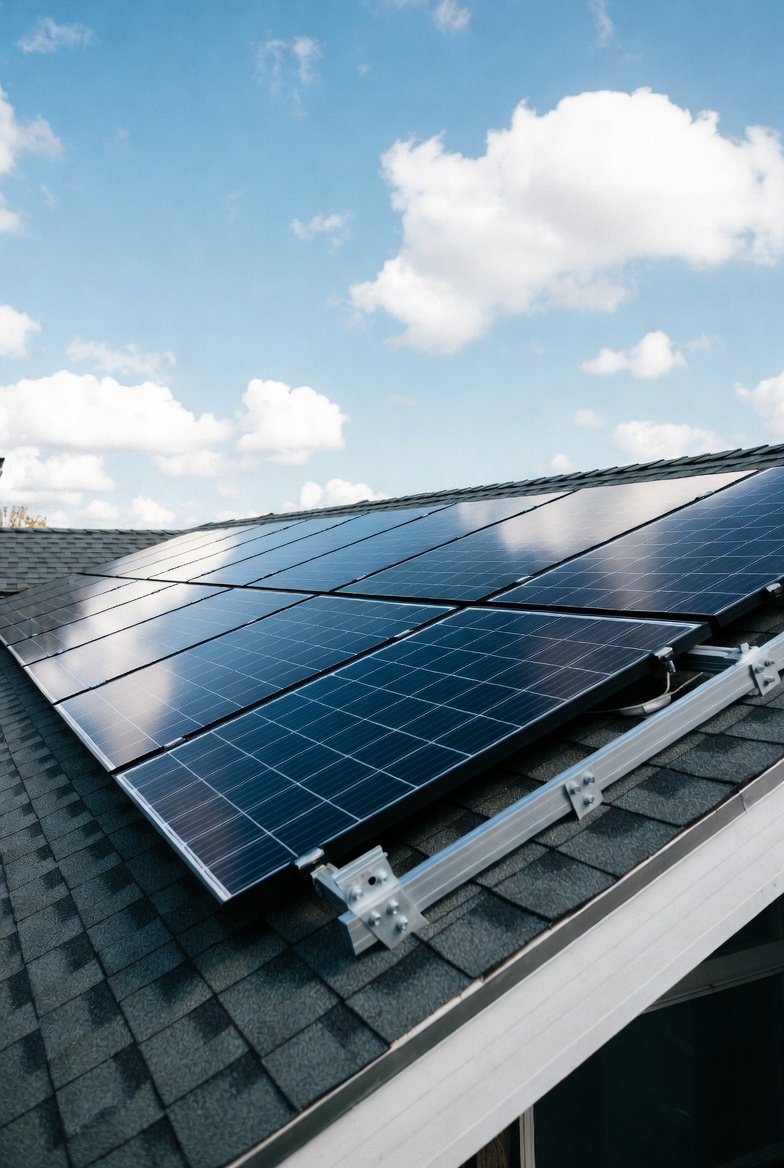
Large-format modules create real constraints:
- roof obstacles (vents, AC units, antennas)
- lift and positioning (awkward for one person)
- mounting rails need enough flat span
- wind uplift and fastener/seal strategy matters more
On many RV roofs, you may get better total output with smaller panels that tile around obstacles instead of one large panel that forces compromises.
For RV layout and roof constraints:
Where 550W Panels Usually Win
If you have space and proper controller matching, 550W panels shine.
They’re typically strongest in:
1) Fixed arrays and open racks
Cabins, sheds, ground mounts, steel racks.
2) Larger off-grid battery systems
Where MPPT is already part of the design and higher-voltage modules are normal.
3) “Fewer modules” builds
Fewer panels can mean fewer mounts, fewer connections, and simpler layout—when the structure supports it.
Battery storage becomes the limiting factor once panel size grows:
Where 550W Panels Often Lose
This section is the difference between an engineer page and a sales page.
A 550W module is often the wrong tool when:
1) Your roof is complicated
Crowded RV roofs, curved surfaces, or inconsistent flat span.
2) You’re trying to stay “simple 12V beginner”
High-voltage module classes punish weak controller planning.
3) Your install must be one-person easy
Weight + size + awkward handling can slow everything down.
4) You actually need portability
Portable use cases are better served by dedicated portable kits, not large-format rigid modules:
A Cleaner Buying Decision (Use This Filter)
Instead of asking “Is 550W better than 400W?” ask these four questions:
- Do I have physical space for a large-format module?
- Can I mount it safely and handle it realistically?
- Do I have an MPPT controller with correct voltage headroom?
- Do I have battery storage to use the energy it can generate?
If you answer “no” to any of these, 550W is often not the right move—regardless of price.
Final Decision Line
A 550W panel can be a strong, efficient building block—but only when the system is designed around its voltage class and physical format. If you treat it like a drop-in “bigger RV panel,” it becomes a fitment and controller-matching problem.
FAQs
Do 550 watt solar panels produce 550 watts all day?
No. 550W is a lab rating. Real output depends on sun hours, temperature, and system losses.
How much power does a 550W panel produce per day?
Often around 1.6–2.5 kWh/day depending on peak sun hours and losses.
How many amps is a 550W solar panel?
Panel-side current is typically in the teens of amps. Battery-side charging amps after MPPT conversion can be much higher (e.g., ~30–40A into a 12V charging system).
Is a 550W solar panel good for RV roofs?
Sometimes, but many 550W panels are large-format modules that don’t fit crowded RV roofs well. Smaller panels may tile better around obstacles.
Do I need MPPT for a 550W panel?
In most practical builds, yes—because the voltage class and efficiency gains usually favor MPPT, and controller voltage headroom becomes critical.