
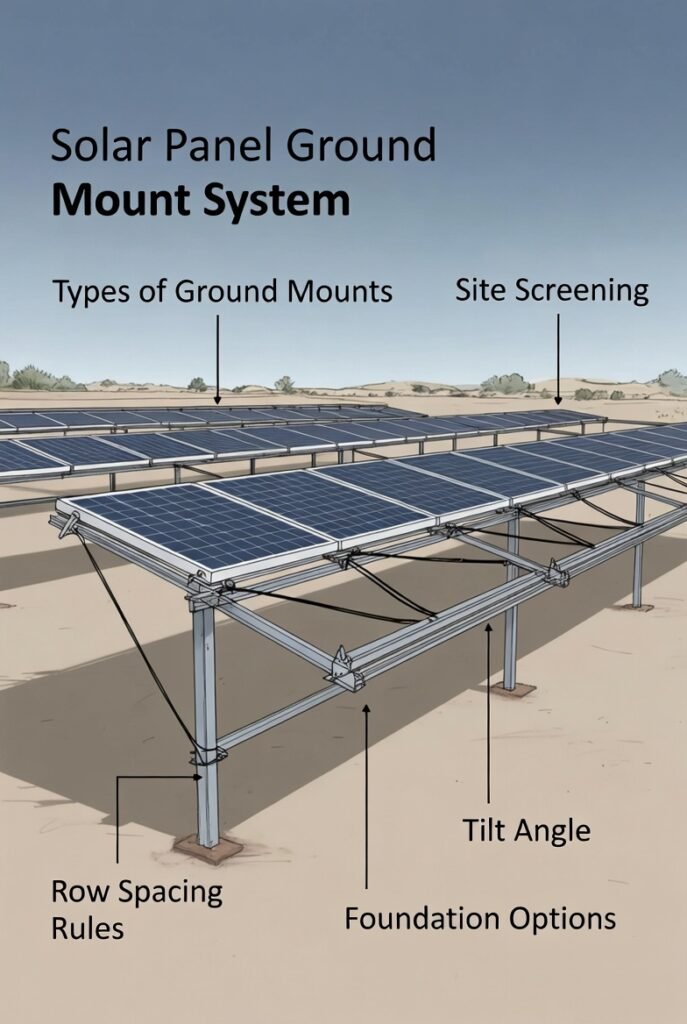
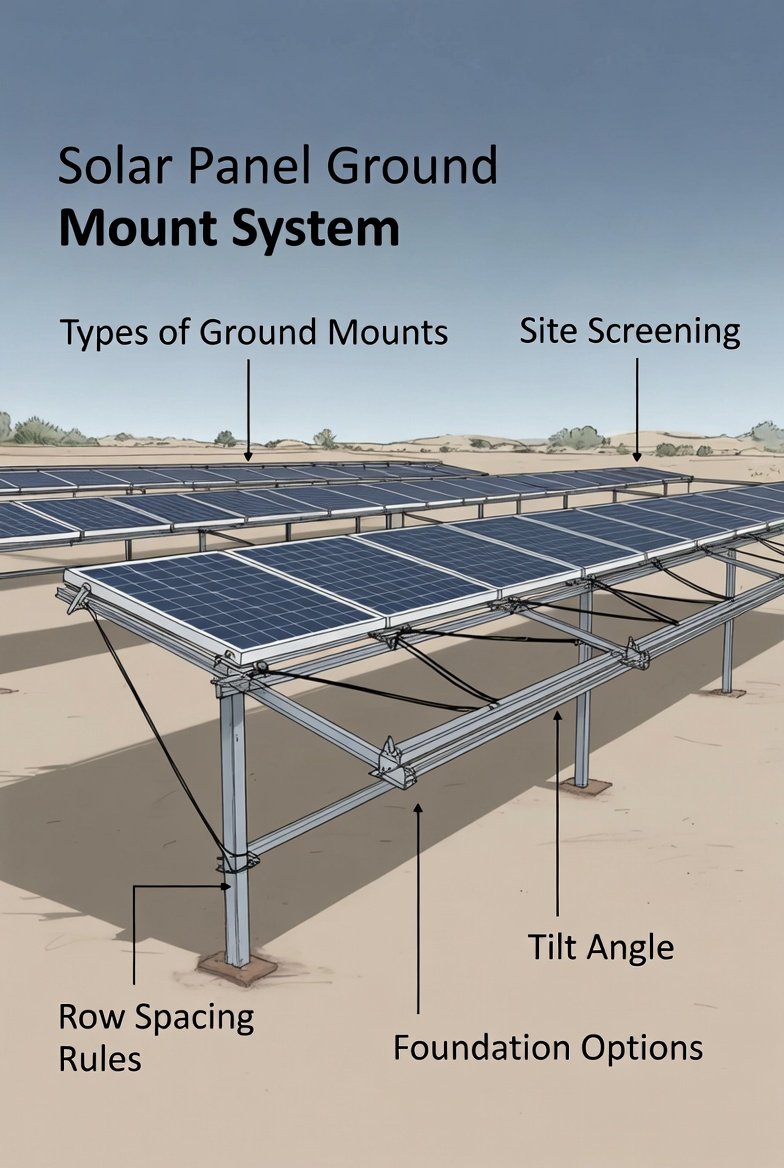
Solar Panel Ground Mount System: Types, Site Screening, and Real-World Layout Logic
A solar panel ground mount system is usually chosen because the roof is the limiting factor. Shade, poor orientation, old roofing, awkward roof planes, or limited roof area can all push a project toward a ground-mounted array.
But “put it on the ground” does not automatically make the design easier.
Ground mounts often add decisions that rooftop solar avoids: slope, soil, foundations, row spacing, trenching, and electrical routing. On the right property, that trade can be worth it. On the wrong property, it turns into an expensive layout problem.
That is why the right question is not:
Is a ground mount better than a roof mount?
The right question is:
Is ground mounting the best structural format for this property and this solar system?
For battery sizing and storage architecture, see
solar battery bank
For hybrid backup inverter logic, see
Quick Answer
A solar panel ground mount system is a racking structure installed on the ground instead of on a roof. It supports solar modules at a chosen tilt and orientation and anchors them using a foundation suited to the site.
The real decision is not just whether the panels can go on the ground.
The real decision is whether the land, foundation conditions, and electrical layout make ground mounting the smarter system format.
How a Ground Mount Fits Into the System
A ground-mounted array still has to fit the same core solar architecture:
Solar panels → charge controller (MPPT) or inverter PV input → battery bank (if used) → inverter → electrical loads
The difference is physical placement.
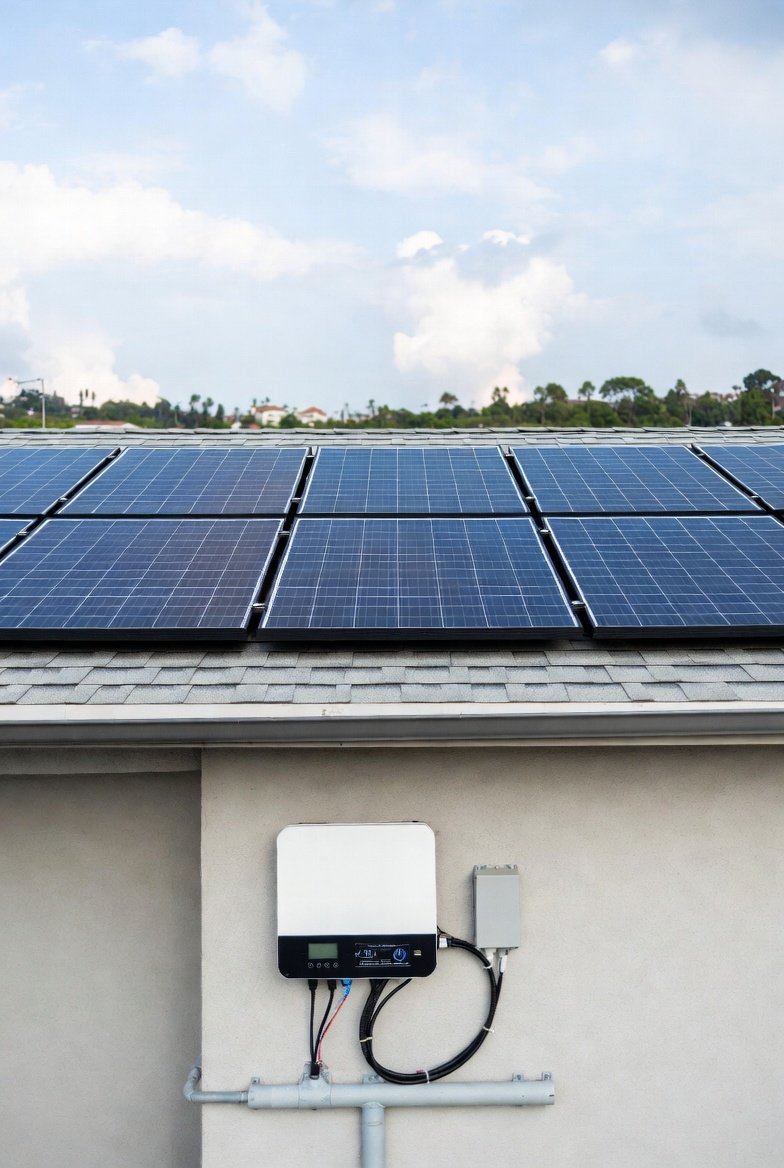
With a roof-mounted system, the array is often close to the building and close to the equipment. With a ground-mounted system, the array is usually farther away. That changes the trench path, conduit planning, disconnect location, wire runs, and sometimes the total installation cost.
For MPPT controller selection and voltage logic, see
For inverter sizing and compatibility, see
Mount Types: Choose the Structural Format First
1) Standard Fixed-Tilt Ground Mount
This is the most common residential ground-mount format.
It uses a wider racking table supported by multiple anchors or posts across a defined footprint. The panels sit at a fixed tilt.
Best fit:
- residential properties with usable open land
- off-grid arrays near an equipment shed
- hybrid backup systems where the roof is shaded or awkward
- projects that may expand later by adding another row
Main advantage:
Stable, serviceable, and predictable over the long term.
Main limitation:
It uses more land footprint than more compact formats.
2) Pole Mount
A pole mount uses one or more central poles instead of a wide rack table.
Best fit:
- tighter footprints
- layouts where extra clearance is useful
- specialty sites where a wider rack table does not fit cleanly
Main advantage:
Smaller footprint and better clearance.
Main limitation:
The structure can be more specialized and sometimes more demanding to engineer.
3) Seasonal-Adjustable or Tracking-Capable Ground Mount
These systems allow either manual tilt adjustment or automated solar tracking.
Best fit:
- performance-focused projects
- sites where the added complexity is justified
- budgets that can absorb more moving parts and maintenance exposure
Main advantage:
Potential for better solar capture in the right conditions.
Main limitation:
Higher cost, more complexity, and more maintenance than a fixed-tilt layout.
Ground Mount Type Comparison Table
Type | Best Fit | Main Advantage | Main Limitation |
Standard fixed-tilt | Most homes and off-grid sites with usable land | Stable, serviceable, easiest long-term layout | Needs more land footprint |
Pole mount | Tighter footprints and clearance-focused sites | Compact layout, higher clearance | Can require a more specialized structural approach |
Seasonal-adjustable / tracking | Performance-driven builds | More sun-capture potential | Higher cost and more moving parts |
Site Screening: The Part That Decides Everything
A good ground mount starts with the site.
Not the rack brand.
Not the panel wattage.
Not the marketing copy.
The site.
1) Usable Open Area
You need sun-exposed land, not just empty land.
That means:
- enough width and depth for the array footprint
- enough sun through the day
- enough room for service access
- enough separation from shading obstacles
Things that quietly ruin a ground-mount location:
- morning or evening tree shading
- future tree growth
- fences or outbuildings that force poor row spacing
- soggy drainage patterns
- a yard layout that becomes unusable after installation
A ground mount is both a solar decision and a land-use decision.
2) Ground Slope
Slope drives complexity quickly.
A gentle slope may still be workable. A steeper slope can force more expensive foundations, more difficult row leveling, more drainage planning, and harder service access.
That is why some sites look good at first glance but become expensive once the layout is actually planned.
3) Soil Condition
Soil decides whether the foundation is easy, difficult, or expensive.
Rocky ground can complicate installation. Weak soils can require deeper anchoring or more engineering. Frost movement can affect long-term stability. Wet ground and poor drainage can complicate both foundations and maintenance.
There is no universal “best” foundation type.
The site decides that.
4) Access for Installation and Maintenance
Even smaller residential projects still need access for:
- delivery and staging
- post or pile installation
- excavation or concrete work
- trenching
- future maintenance and repairs
A location that looks simple on paper can become expensive if access is poor.
5) Electrical Tie-In Distance
This is where mounting becomes true system design.
A roof array is often close to the building electrical and inverter location. A ground mount may be much farther away.
That affects:
- trenching length
- wire sizing
- conduit planning
- disconnect placement
- service access
- overall installation cost
A sunny area in the yard is not automatically a good solar location if the electrical tie-in path is awkward or expensive.
For broader off-grid system planning, see
6) Setbacks, Rules, and Utility Constraints
Ground mounts use land, not roof space.
That means:
- setbacks can matter more
- visual placement can matter more
- local utility or permit rules can affect the layout
- some apparently good array locations may not be practical in the real permitting path
A structurally workable location is not always a legally clean location.
Row Spacing and Footprint: The Most Overlooked Layout Issue
One of the biggest mistakes in ground-mount planning is underestimating row spacing.
If rows are too close together, the array can self-shade. If spacing is too tight, service access also becomes worse.
That means row spacing affects:
- land footprint
- winter shading performance
- maintenance access
- long-term usability of the system
A ground mount is not just “posts and panels.”
It is a layout that has to remain workable for years.
Foundation Options: The Structural Decision Most Articles Skip
Most weak articles say ground mounts need anchors and stop there.
That is not enough.
The foundation determines how the structure handles:
- wind uplift
- lateral loads
- frost movement
- long-term settlement
Common foundation approaches include:
Concrete Piers
Best when conventional footing work is practical and the site supports excavation and concrete placement.
Tradeoff:
More digging, more disturbance, and more concrete logistics.
Driven Piers
Best when the soil supports driven members effectively.
Tradeoff:
Performance depends heavily on actual ground conditions and engineering needs.
Helical Piles
Best when strong anchoring and controlled excavation are both important.
Tradeoff:
Still requires proper engineering, correct depth, and good installation quality.
Ballast Approaches
Best in specialized cases where penetration is undesirable and the site supports that design.
Tradeoff:
Weight, footprint, and wind behavior can change feasibility.
The key point is simple:
The foundation is not a generic product choice. It is a site-and-loads decision.
Why Ground Mount Systems Can Beat Rooftop Solar
Ground mounts are not automatically better, but they can be better for clear reasons.
Better Orientation and Tilt Freedom
A roof forces the array to follow roof geometry. A ground mount gives more control over orientation and tilt.
Easier Maintenance Access
Cleaning, inspection, and repair are usually easier on the ground than on a roof.
Expansion Logic
If land allows it, adding another row later can be easier than trying to squeeze more solar onto a fragmented roof layout.
Cleaner Structural Separation
Sometimes the roof is simply not the right place for the solar design. In those cases, moving the array to the ground can create a cleaner overall system.
For storage chemistry planning, see
Where Ground Mount Systems Lose
Ground mounts also have real downsides.
They Usually Cost More
They often require more steel, more labor, more site work, and more foundation work than rooftop arrays.
They Use Land
The best sunny area in the yard may also be valuable outdoor space.
They Add Site Complexity
Slope, soil, setbacks, access, and trenching become real parts of the design.
They Make Electrical Routing More Important
Once the array is separated from the inverter, batteries, or main service area, the wire path becomes part of the architecture rather than an afterthought.
When a Ground Mount Usually Makes Sense
A ground mount is usually a strong candidate when most of these are true:
- the roof is shaded, aging, undersized, or poorly oriented
- the property has usable sun-exposed land
- the slope and soil support a practical foundation plan
- trench distance is reasonable
- setbacks and local rules do not create major layout problems
- easy maintenance access matters
- future expansion matters
- the budget can support extra structural and site work
If the project is RV- or outbuilding-related, tie the mounting decision into mobile power planning so the array is not oversized or underused.
If the project is portable-first rather than permanently mounted, do not force a ground-mount solution onto it.
portable-solar-panel-kit
When a Ground Mount Is Usually the Wrong Choice
A ground mount is often the wrong answer when:
- the roof is already ideal
- the yard is small, shaded, or awkwardly shaped
- trenching distance is long or routing is messy
- soil or frost conditions make foundations unusually costly
- setbacks or local rules create a compromised layout
- the extra site work does not justify the gains over rooftop solar
That is not anti-ground-mount advice.
That is simply format discipline.
Quick Verdict
A solar panel ground mount system is worth it when the site earns it.
If the land is sunny, the slope and soil cooperate, the trench path is reasonable, and the layout can be built serviceable, a ground mount can deliver real benefits:
placement freedom, easier service access, and cleaner expansion logic.
If those conditions do not cooperate, ground mounting becomes an expensive workaround.
Choose the format based on:
site fit + structural fit + electrical fit
Not on rack marketing.
Conclusion
A solar panel ground mount system is not just hardware.
It is a structural format decision that has to fit the land, the trench path, the equipment location, and the full solar architecture.
Start with site screening:
usable open area, slope, soil, access, trench distance, setbacks, and tie-in practicality.
Then choose the mount type:
standard fixed-tilt, pole mount, or a more specialized adjustable/tracking format.
Then make sure it still fits the rest of the system:
array voltage, controller or invert
rter placement, battery location, and future expansion path.
If you keep it system-first, a ground mount can be one of the cleanest solar formats available.